Category Archives: Identity
Guest Post Series: Five Questions on…Pregnancy (with Lisa)
 Pregnancy

with Lisa Nelson
1) Describe your experience with pregnancy (trying, discovering, being, labor/delivery, after).
Pregnancy with Malia was new and exciting since I had never been pregnant before. I experienced a lot of firsts with her, like feeling her move the first time which was crazy and foreign 🙂 I loved being pregnant, and was so excited when we found out we were pregnant with her. I knew even before the pregnancy test that I was pregnant because I had heart burn which I had never had before, so I thought something was different. I remember the first time I saw the ultrasound of her, I cried seeing her little heartbeat flutter on the monitor! After having Malia we decided to start trying for baby number 2 about two and half years later. We were super excited when we found out we were pregnant. We had shared with our families when I was six weeks pregnant. During my seventh week, I miscarried the baby. We were heart broken by the loss. About four months after our loss we discovered I was pregnant again. We didn’t share it with anyone because we were very fearful of the possibility of losing another baby. I don’t think I actually told anyone until into my second trimester, and even then we didn’t know how to share. For me I had a lot of fear about losing the baby. When I was 25 weeks pregnant, I had a heart procedure after finding out that I had an arrhythmia. I was super scared of losing the baby, but because my heart continued to race at a rapid heart rate both my heart and OB docs decided the safest thing for both of us was to operate. So I had a heart procedure (which I was awake for). Fortunately I could feel the baby move during the procedure which calmed my nerves. When I was 33 weeks pregnant, I had a test come back that was positive for signs of preterm labor and was put on bed rest. You can imagine the fear I had of the baby being born to early and the possibility of losing him. Micah was born 10 days early, and was big and healthy! I was relieved after his birth when I got to hold him, see him, and touch him knowing he was finally with us and safe. While on bed rest with Micah I had a lot of time to reflect on being pregnant. I loved it, even though I was uncomfortable and tired of being in bed. And even after everything I went through with Micah’s pregnancy I wouldn’t have changed anything.2) How has that experience affected the way you think about your body and/or your self-image?
After my miscarriage, I had a lot of doubts about myself. I thought maybe God didn’t think I was a good enough mom to Malia and that this was His way of telling me I shouldn’t have another baby. Eventually I felt His healing in those areas of woundedness and realized I am a good mom, but like all moms have challenges. I struggled with my body image more after Micah was born because I was frustrated that I couldn’t fit into my clothes and felt like I didn’t have time to exercise or do anything for myself. After Micah was 5 months old, I realized that I was struggling with postpartum depression. I didn’t see the signs myself, but Chris and my close friends had noticed changes in my behaviors. Looking back I realized that I felt like a terrible mom who couldn’t do anything for my family. Now I’m feeling better and being treated for the depression, thankfully I’m much more like myself again, and I can see more clearly that having children and balancing my life looks different than I anticipated, but I do love my children, my husband, and even myself. I realize that no mom is perfect, and that my body will never be the same, but then it never has stayed the same. As for my body… I do fit into my clothes again and actually have dropped a size… probably because of nursing and running after two kids all day. But I still have marks on my tummy from where Micah stretched me out, and my skin is not toned, but I’m okay with that. I actually laugh at it sometimes because it reminds me how much bigger I was with Micah than I was with Malia. If you saw me you would agree 🙂 My tummy was much more stretched by him, but he was also almost 2 lbs. bigger!3) How has that experience affected the way you relate to others?
I think I am able to look at even the moms who I think are perfect, and realize that they too are managing in the best ways they can, and while they make some things look so easy they are probably struggling in other areas. I think I also have a greater understanding of the fact that after children we don’t have the same energy we use to, and therefore sometimes things like exercise and eating right get thrown out the door because we’re too tired, or eating on the go in between balancing the kids naps, meals, nursing, and other activities. I find that I relate more to moms who feel like life is always on the go and that having a family is a juggling act. I learn a lot from moms who can give me advice on the importance of time alone, or “quiet time” for mom. I also find that I’m more vulnerable to share what’s going on with me because I know that if I can talk about what I’m going through and experiencing, my guess is that someone else has been there or is also there and can relate.4) How has that experience affected your spiritual life?
I’m learning more about patience and grace daily. Patience for my kids and grace for myself. I’m not a super mom, even though I joke about being one. I’d like to think I’m super enough for what God’s given me. I do find that my quiet times are not like they use to be. I miss having time alone, but I realize that my prayer life goes through seasons and those seasons affect my spiritual journey. I’m discovering that I spend more time praying in the car, in the shower, and when I’m nursing Micah than when I can carve out my own quiet space. So I look forward to times when Chris can take both kids and give me a few hours of quiet that I can refresh myself. Having kids makes me wonder about how God feels about us as his children… life gets busy regardless of kids and feels exhausting… yet God always finds and makes time for us.5) What word of wisdom or encouragement would you offer other people on a similar journey?
Give yourself lots of grace. God knows what you are going though and more than likely you are not alone. Find people you trust that you can talk with or sit with. Take deep breaths and remind yourself that your kids are a blessing, and imagine the way God is smiling at you even when you do crazy things.
What about you?
Have your own answers to these questions? Why not share them? Email your responses and a recent picture to bodytheologyblog at gmail dot com. You can also post anonymously if you wish.
Guest Post Series: Five Questions on…Exercise (with George)
Exercise
with George Ratchford
1) Describe your relationship to/experience with exercise. If it has changed over time, describe the change.
I have never been one to exercise for the sake of exercise. I need a goal or a purpose. In the past I have stayed in shape so that I can play sports and be strong for surfing. It’s also for the purpose of feeling better, sleeping better, and self-confidence. Recently, I trained for my first ever half-marathon. The great purpose was to raise money for clean water wells in Africa through Team World Vision. I trained with a team of 30 people from two churches. It was communal, it had a greater purpose and allowed me to push myself to new limits.2) How has that relationship/experience affected the way you think about your body and/or your self-image?
It makes a lot of difference. I feel sharper mentally and spiritually. I feel like I look better and have a better “bounce” to my step. It just feels good.3) How has that relationship/experience affected the way you relate to others?
Since it is mostly about sports and surfing it has all been connected to the relational side of things. The recent Team World Vision experience was phenomenal as it connected the team on a deeply spiritual level.4) How has that relationship/experience affected your spiritual life?
Brings me discipline. Gets me outside. Allows me to connect with others. These are not always the most powerfully spiritual moments, yet they have a way of drawing my attention to God more often. So I would say that it affects it in a subtle yet profound way. It is a discipline that keeps me filled with joy and Christ said he came to bring us a fullness to life (John 10:10).5) What word of wisdom or encouragement would you offer other people on a similar journey?
Allow exercise to fit into the Great Commandment. Make sure the discipline is a part of loving God with your entire self. Also, to use it as a way of self care and loving one’s self more deeply (confidence). Lastly, make sure exercise is communal in some aspects so it allows you to connect with your neighbor.
What about you?
Have your own answers to these questions? Why not share them? Email your responses and a recent picture to bodytheologyblog at gmail dot com. You can also post anonymously if you wish.
Guest Post Series: Five Questions on…Dating/Singleness (with Tammy)
Dating/Singleness
with Tammy Waggoner
1) Describe your relationship to/experience with dating/singleness. If it has changed over time, describe the change.
Hmm. I’ve been single for 31 almost 32 years. For the most part I consider my relationship with singleness like riding a roller coaster. There are times where I’m perfectly fine, I look at families or couples and I’m happy for them without a hint of bitterness. But I admit to times where I am absolutely bitter toward everyone else that has exactly what I want. It’s funny because I was a boy chaser even when I was a kid. In Elementary school I used to trade boyfriends like pudding cups at lunch. I would chase boys hoping that one would be my boyfriend. In High School that didn’t change much, I was now chasing them around the church and kissing them in the red room (a day care room with a bright red EXIT sign). In college I was still boy crazy and went to parties kissing boys and sitting on their laps. I was a tease but I always had a man on my arm and at bars I always had a dance partner. In my adulthood I have dated using less out there forms of trying to be in a relationship. I’m internet dating which brings its own stigmas and problems. I know that I am complete in my singleness. I am a complete person who sometimes gets lonely and misses the fun of being in relationship during the in-between times of relationship. I’m not looking for someone to complete me just a partner in crime.2) How has that relationship/experience affected the way you think about your body and/or your self-image?
My self-image is pretty intact. There are moments when I doubt my ability to catch a mate but that rarely has to do with my self-image or my body image. Most of the time it has to do with how much of myself I should show at the beginning or even at the superficial stage of a relationship. My body image is pretty healthy but I do have certain parts of myself I wish I could change. The one thing that I wish I could change is my brokenness. I have a past that is full of damage and brokenness and scars and there are times when those scars seem insurmountable. But other times they feel behind me. So it’s a toss up. Not quite like a roller coaster, more like I take two steps forward and seem to take one step back so that I am constantly getting somewhere while also being stuck in the past, a contradiction no matter how you look at it. No matter my past and brokenness, I love me. I love my tattoo even if that make others turn away from me. I love my glasses even if they present my smarts on the outside, let’s get serious there’s no way to hide them. I love my breasts, their just the right size and I’m proud of them, for years it was like two bee stings :). I love my legs, they’re long and yet I’m short. I love my dainty hands and my hips and my eyes and some-days my hair, but that’s mostly because I’m growing it out and the in-between stage is annoying. I am completely happy with me, which I think makes me less likely to fall for any line or anyone because I am confident in who I am and what I offer and bring to a relationship from the inside out.3) How has that relationship/experience affected the way you relate to others?
I kind of already answered this above but I’ll give it another go just in case :). Because my self-image inside and out is strong I represent a strong person. I relate to people from a real place with real understanding of who I am and I hope it doesn’t come off as arrogant but I’ve learned along the way that changing yourself for another person does nothing for you. In the end you lose part of yourself and miss out on something because you chose not to be yourself.4) How has that relationship/experience affected your spiritual life?
The brokenness that I was talking about earlier plays a huge part in my spiritual life. God through prayer and God through friends has taught me how valuable I am and he works at chipping away every part of my self that is still false. For this to make sense I need to reveal a bit more about myself. Abuse, of a sexual nature, has been a huge part of my life. I was abused as a child, in my college days and a little right after college. Abusers are never silent in their abuse. They are MEAN and if they say crap often enough and with enough VIOLENCE you begin to believe them. They put in your mind a false self, a self that allows them to chip pieces of you away. Over the past 5 years God has been guiding me through smashing these false pieces to oblivion. He still works with me on certain pieces that have held on a lot tighter. We work together to smash the false to let the real shine through. I am transparent with God so that together we can beat back the false pieces of me.5) What word of wisdom or encouragement would you offer other people on a similar journey?
Advice. Hmm….don’t present a false self to anyone. Be yourself in any situation. If you spend your time presenting a false self to anyone then you won’t know when you are really being yourself. Also boundaries are really important. We don’t lay our entire selves out on the line for everyone at the beginning because people need to earn our trust. It’s not something we should freely give. In my earlier days, I used to broadcast my virginity (now that you know my past you know how false that was) or my desire to go to seminary because I thought I could scare people away from me. The problem with that is BAD or misguided people feed on that crap and it allows people into your life that have no business being there. Trust yourself that you are enough. For an entire season in my life I had a post-it note on my mirror that said you are beautiful and soon I began to believe it. Put reminders all over your space to remind yourself that you are enough and you are worth protecting and worth waiting for. Don’t settle for half your worth and keep forging and pursuing what you are worth, soon the roller coaster will reach another high point and your bitterness will falter and you will see your singleness for what it is: a time to get yourself right and prepare yourself to be with someone else without losing who you are.
What about you?
Have your own answers to these questions? Why not share them? Email your responses and a recent picture to bodytheologyblog at gmail dot com. You can also post anonymously if you wish.
The Illusionists
You may have noticed this picture trending on Facebook and Pinterest this week.
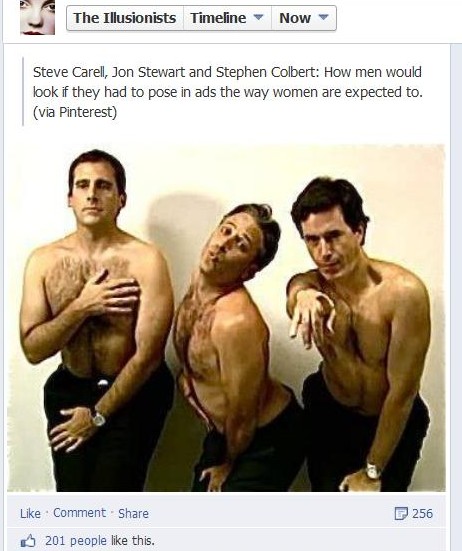
I ran across it myself, which led me to discovering The Illusionists, a documentary that is currently in post-production and promises to be a balanced and informative look at the commodification of the human body. That’s right up our alley here at HBTB, so I thought I’d do a little plugging for them. Check out the video below.
I’m in no way affiliated with The Illusionists, but I’m looking forward to their finished product! You can also find out more about body image and media literacy on The Illusionists blog.
Bumper Sticker Wisdom

Women who behave rarely make history.
In general, I’m not a fan of bumper sticker wisdom. The pithy sayings might be humorous, clever, even witty, but rarely are they truly wise. They usually over-simplify or take an extreme view that only alienates those who disagree.
But this one I loved.
I loved it so much I had to snap a shot with my phone on the poor unsuspecting driver innocently pumping gas in front of me, whom I cut out of the shot before posting. I did my best to be discreet, but really, how does one take a picture without appearing to take a picture? I’m pretty sure he saw me and thought I was crazy.
The picture is terrible, I admit. You probably can’t even read the sticker after all that. It says, “Women who behave rarely make history.” (You may recognize the line from Laurel Thatcher Ulrich’s book.)
I love that. It reminds me of Kathy Escobar’s post last year on being an ex-good-christian-woman. Or more recently the Brain Pickings article on Mark Twain’s children’s book for mischievous girls.
I love it so much I’ll say it again: Women who behave rarely make history.
Pithy, yes. Simple, yes. Wise, oh yes!
Now, let’s make some history, ladies!
Forward Friday: The Meaning of the Story of God
Originally posted April 6, 2012
One of the most significant elements in body theology is the actual, physical life, death, and resurrection of Jesus. That’s why Christmas, Holy Week, and Easter Sunday are so pivotal. We Christians are who we are because of who Christ is and what Christ did for us.
Sometimes looking at the big picture of the course of biblical history can help us understand the rhythm of the liturgical year. Although this year’s Easter celebration is over, let us not be so hasty to rush on to the next big thing. Let’s take some time to pause and allow the passing of this season to inform the season to come.
As you reflect this weekend on the passing of Holy Week and Easter and the coming of Pentecost, read back over some of the key elements of the story of God from our little flash Bible course to dig into the significance of what we are about to celebrate. Share your thoughts in the comment box below.
What stands out as particularly meaningful to you?
1. God takes evening walks with Adam and Eve in the garden.
2. Becoming aware of their nakedness and feeling ashamed causes them to hide from God.
3. God’s people become afraid of God and ask Moses to speak to God on their behalf.
4. God’s people are afraid even of the glory of God reflected on Moses’ face, so he has to wear a veil until the glory fades.
5. God instructs the people to build the Ark of the Covenant, where God’s presence will be confined among them.
6. The people never touch or open the Ark of the Covenant because it is so holy.
7. The Ark lives in its own tent among them, called the Tabernacle, where the people come to worship God.
8. After Moses, God speaks only to specific people God chooses, usually prophets, kings, or priests. These chosen few share God’s words with the people–who often do not listen.
9. To see the face of God is to die, and even the prophet Elijah–who asks to see God’s face–covers his face with his robe before meeting God at the mouth of the cave.
10. Once God’s people settle down in one place and begin to build houses instead of tents, God instructs King Solomon to build a temple for God to live in.
11. God’s presence is reserved for the Holy of Holies–a small area within the temple restricted from everyone where the Ark is kept, the entrance to which is blocked with a thick curtain.
12. Once a year, on the Day of Atonement, the high priest goes through an elaborate cleansing ritual in preparation to enter the Holy of Holies and sprinkle the blood of the sacrificed animal to atone for the people’s sins. (They even tie a rope around his foot each time in case he dies from the experience of being with God and has to be dragged out to be buried since no one else is allowed to enter the Holy of Holies, even to retrieve a dead body.)
13. Then Jesus is born, and he is called Emmanuel, which means “God with us.”
14. No longer is God among the people yet blocked from their access. Jesus lives with the people, learns and grows with them, eats and drinks, sleeps, speaks, heals, reprimands, and teaches.
15. Jesus says that those who see him and know him also see and know God.
16. Jesus is anointed at Bethany for his coming death.
17. When the people celebrate Jesus’ entrance into Jerusalem–what we call Palm Sunday–they acknowledge that Jesus is fulfilling the long-anticipated role of the Messiah, the one who has come to save them and restore the original order as God intended.
18. Jesus washes his disciples’ feet as an example of their role in each others’ lives.
19. Jesus breaks bread and passes the cup of wine to his disciples to foreshadow his impending arrest and execution.
20. Jesus prays in the garden with his disciples nearby–by some accounts so fervently that the capillaries break on his forehead and he begins to sweat blood–not only that he might yet be spared his role as the sacrifice for the people’s sins but also that he accepts that role.
21. Jesus is arrested, abandoned and denied by his disciples, beaten, mocked, and sentenced to death by Rome’s most barbaric form of execution.
22. Jesus is forced to carry the crossbeam through the crowded streets of Jerusalem up to the site of his execution.
23. Jesus is too weak to complete the trip and collapses. A member of the crowd is chosen at random by the guards to carry the crossbeam for Jesus the rest of the way.
24. At Golgatha, Jesus is stripped naked (yes, as naked as he was born).
25. The guards attach Jesus to the crossbeam with iron spikes through his wrists and to the stake with spikes through his ankles and raised to hang between two thieves until his struggle for breath overcomes him and he gives up his spirit to God and completes the sacrifice.
26. At the moment of his death, there is an earthquake and the curtain separating the Holy of Holies from the rest of the temple is torn in half from top to bottom.
27. Jesus’ execution lasts only six hours, considerably less time than most people endured the experience.
28. Jesus is buried and mourned, and the disciples hide in fear that they will be arrested and executed next.
29. The women at the tomb discover Jesus’ resurrection early in the morning three days later. They become the first bringers of the good news (gospel) that Jesus is alive.
30. Jesus appears to his disciples and to many other people over the 40 days following his execution, eating and drinking with them and allowing them to touch him to prove that he indeed has retaken physical form.
31. Jesus ascends into the clouds after promising to send his spirit to be with his followers and to return again one day soon to bring the kingdom of heaven.
32. The disciples wait and pray until they experience the promised presence of the Holy Spirit during Pentecost.
33. The disciples become apostles, who preach the good news (gospel) that Jesus came back to life to all who are gathered in the street. Miraculously, each listener hears the words in his or her own language.
34. The apostles perform many other miracles by the power of the Holy Spirit in the name of Jesus, and many who hear believe. Thus the Church is born, and all who believe in the good news that Jesus came back to life are filled with the Holy Spirit…even the Gentiles!
Will I Be Pretty?
I know this doesn’t have anything to do with Holy Week or Easter or anything in our theme last week and this week, but I couldn’t resist. If only we were all so enlightened, there would be no need for blogs like HBTB!
And then, after Holy Week…
Originally posted April 5, 2012
Last week, we looked at the big picture of the history of God’s relationship to people up to the Day of Atonement. Then, we looked at the entrance of Jesus into the story. On Good Friday, we considered the passion, resurrection, and ascension of Christ. Now that we’ve celebrated Easter Sunday, let’s look at the coming of the Holy Spirit and the implications of this story for body theology.
32. The disciples wait and pray until they experience the promised presence of the Holy Spirit during Pentecost.
33. The disciples become apostles, who preach the good news (gospel) that Jesus came back to life to all who are gathered in the street. Miraculously, each listener hears the words in his or her own language.
34. The apostles perform many other miracles by the power of the Holy Spirit in the name of Jesus, and many who hear believe. Thus the Church is born, and all who believe in the good news that Jesus came back to life are filled with the Holy Spirit…even the Gentiles!
When I was little, we used the phrase Holy Ghost. Some people might have found that phrase a little scary. To me, it was just a name, as incorporeal and intangible as today’s more common Holy Spirit. Growing up Presbyterian, there was never much emphasis on the Holy Spirit at all. We talked a lot about God as The Father and Jesus as The Son, but God as The Holy Ghost was just something we said as part of the Nicene Creed each week in the church service.
I’ve come a long way in my journey with the Holy Spirit. That’s a post for another day. What I want to share today is the continued trajectory of the story of God.
Last week, we looked at the beginning of the story of God when God was present with Adam and Eve, walking in the garden. Through the entrance of sin and shame, a barrier went up that kept the people of God from God’s presence with them. As we walk through the story of God, we see God living nearby, but there is always something keeping the people from direct contact with God–whether that’s shame, fear, or the belief that they are too unclean or unholy.
But God was determined to be with the people again. On Wednesday and Friday, we looked at the life, death, and resurrection of Jesus–God in human form. God broke the barrier by making the ultimate blood sacrifice so the people would never again be too unclean or unholy to be present with God. But Jesus’ physical existence on earth–like ours–was only temporary, even after death.
So God sent the Holy Spirit–the presence of God–to remain in the world with the people of God and to actually live within the people, making their physical bodies into temples. Now, people don’t have to go anywhere to be present with God. No one can keep us away from God or force us to stay at a distance from God’s presence because God is now present inside the human body!
If that’s not the most exciting thing ever, I don’t know what is! Our bodies house the presence of God. God’s presence inside us is what changes us, makes us new, and makes us holy. There is nowhere we can go where God is not present. There is nowhere we can go that is not made holy by God’s presence there. The curtain has been ripped open. The Spirit of God has been released into the world and into the body of every person who believes.
That is what body theology is all about. That is why our bodies matter to our faith. That is why the physical reality of God in the world matters to our theology.
And that is what Holistic Body Theology Blog is all about.
It’s Holy Week! (Part 3)
Originally posted April 4, 2012
Monday, we looked at the big picture of the history of God’s relationship to people up to the Day of Atonement. Wednesday, we looked at the entrance of Jesus into the story. Today, let’s look at the Passion of Christ and the rest of the Jesus story.
21. Jesus is arrested, abandoned and denied by his disciples, beaten, mocked, and sentenced to death by Rome’s most barbaric form of execution.
22. Jesus is forced to carry the crossbeam through the crowded streets of Jerusalem up to the site of his execution.
23. Jesus is too weak to complete the trip and collapses. A member of the crowd is chosen at random by the guards to carry the crossbeam for Jesus the rest of the way.
24. At Golgatha, Jesus is stripped naked (yes, as naked as he was born).
25. The guards attach Jesus to the crossbeam with iron spikes through his wrists and to the stake with spikes through his ankles and raised to hang between two thieves until his struggle for breath overcomes him and he gives up his spirit to God and completes the sacrifice.
26. At the moment of his death, there is an earthquake and the curtain separating the Holy of Holies from the rest of the temple is torn in half from top to bottom.
27. Jesus’ execution lasts only six hours, considerably less time than most people endured the experience.
28. Jesus is buried and mourned, and the disciples hide in fear that they will be arrested and executed next.
29. The women at the tomb discover Jesus’ resurrection early in the morning three days later. They become the first bringers of the good news (gospel) that Jesus is alive.
30. Jesus appears to his disciples and to many other people over the 40 days following his execution, eating and drinking with them and allowing them to touch him to prove that he indeed has retaken physical form.
31. Jesus ascends into the clouds after promising to send his spirit to be with his followers and to return again one day soon to bring the kingdom of heaven.
There are so many wonderful moments in this part of the story of God. Jesus, a physical human being, dies a physical human death (of the worst kind), and is resurrected to again be a physical human being. The women are the first evangelists. Jesus promises to leave his spirit with those who believe in him.
But my favorite moment is the moment of Jesus’ death when the curtain is ripped in two. Remember the curtain? That piece of fabric hanging in the entrance to the Holy of Holies? It served as a reminder of the barrier between God and God’s people. It blocked people from God’s presence with them.
In fact, only the people considered to be the cleanest and most holy were even allowed near the Holy of Holies. Even the high priest, the holiest person out of all of God’s people, was only allowed inside once a year to sprinkle sacrificial blood on the Ark to atone for the sins of the people. God was just too holy to be with the people. The people were just too unholy to be with God.
But God came to the people anyway, in the physical human form of Jesus. God became the ultimate blood sacrifice–the last and final atonement for all the sins of all people everywhere throughout all of time. God ripped the curtain (top to bottom) at the moment of Jesus’ death to show the people that there was no more need to separate the holy from the unholy–the sacred from the secular.
And when I think that God, his son not sparing,
sent him to die, I scarce can take it in,
that on that cross, my burden gladly bearing,
he bled and died to take away my sin.
Then sings my soul, my savior God, to thee.
How great thou art! How great thou art!
So get ready for Easter, people. The curtain gets ripped today. The body of Jesus gets buried and the spirit of Jesus enters the place of eternal damnation on Saturday. And then Sunday–oh glory!–we get to celebrate the living-breathing-walking-talking-eating-drinking-teaching-healing-actual-physical-human/divine-Jesus for defeating death, ending forever the need for blood sacrifice, forgiving sin, and making possible the presence of God in the world and in the body of every believer everywhere until the kingdom of God returns to us again one day soon.
People, get ‘a ready. Jesus is ‘a comin’!
It’s Holy Week! (Part 2)
Originally posted April 3, 2012
Monday, we looked at the big picture of the history of God’s relationship to people up to the Day of Atonement. Today, let’s look at the entrance of Jesus into the story.
13. Then Jesus is born, and he is called Emmanuel, which means “God with us.”
14. No longer is God among the people yet blocked from their access. Jesus lives with the people, learns and grows with them, eats and drinks, sleeps, speaks, heals, reprimands, and teaches.
15. Jesus says that those who see him and know him also see and know God.
16. Jesus is anointed at Bethany for his coming death.
17. When the people celebrate Jesus’ entrance into Jerusalem–what we call Palm Sunday–they acknowledge that Jesus is fulfilling the long-anticipated role of the Messiah, the one who has come to save them and restore the original order as God intended.
18. Jesus washes his disciples’ feet as an example of their role in each others’ lives.
19. Jesus breaks bread and passes the cup of wine to his disciples to foreshadow his impending arrest and execution.
20. Jesus prays in the garden with his disciples nearby–by some accounts so fervently that the capillaries break on his forehead and he begins to sweat blood–not only that he might yet be spared his role as the sacrifice for the people’s sins but also that he accepts that role.
This is what I love about the Jesus part of the story of God. Here we see Jesus in his human vulnerability. Though he is fully divine and capable of changing the end of the story, Jesus is also fully human and willingly becomes the final blood sacrifice as the atonement for the sins of the people–this time not only the people of God but all people everywhere throughout the course of history.
The scene in the garden is one of my favorite Jesus moments. We see Jesus at his most intimate, praying to God not for the sake of others but for his own sake. We see the intense struggle between the divine and human in Jesus. This is no small matter, this business of execution and sacrifice. This is not easy or pleasant, but it is worthwhile and shows the extent of God’s love for the people–of Jesus’ love for the people, all people.
Blessed is the one who lays down their life for the sake of a friend. And Jesus has called us friends.
I like to think the blood Jesus sweats during his prayer foreshadows the finality of his sacrifice. Like the blood sprinkled on the Ark of the Covenant in the Holy of Holies on the Day of Atonement, the first drops of Jesus’ blood are spilled in the garden as he struggles to accept his role as the animal sacrificed on the temple’s altar.
But my favorite moment is still coming…

 Holistic Body Theology