Category Archives: Physicality
Forward Friday: Write Your Letter
On Wednesday, I contributed to the SheLoves syncroblog on writing love letters to our bodies.
This weekend, you guessed it, try writing a love letter to your body. It’s a strange and unusual experience, but you might be surprised what comes out of it.
This is a chance to break the refrain that runs through our heads, reminding us what we don’t like about ourselves. Be bold. Be honest. Be funny. Be vulnerable. Embrace the body you have, just as it is right now.
Even if you already have a healthy body image, this is a great opportunity to reflect on your unique relationship to your body. It is, after all, the temple of the Holy Spirit, right?
Not sure where to start? Check out some wonderful examples on the SheLoves website.
Not just for women! Men, you go right ahead and write your body a letter, too.
If you feel comfortable sharing, post in the comment box below, or just leave a link to your blog or Facebook post. I’d love to read what you come up with!
Forward Friday: On the Act
On Monday we talked about the act of writing it down and on Wednesday about the act of creating art. This weekend, take some time to explore your spirituality and personal growth in a tangible way.
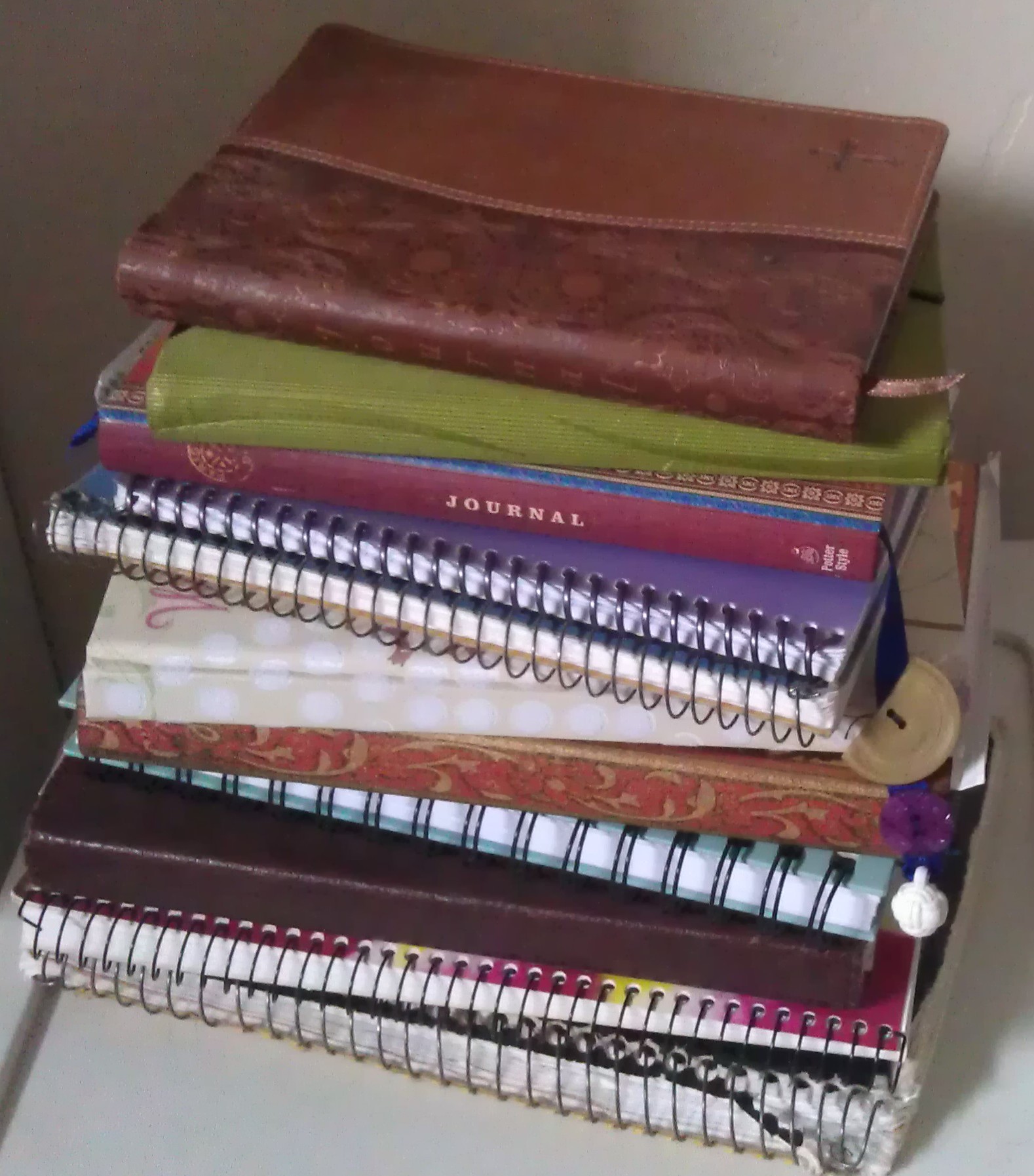
All my journals from the past six years, except one or two I can’t find!
Here are some ideas to get you started:
- write it down in a journal
- create a collage
- create a mural
- paint
- write it on a t-shirt and wear it
- use play dough
- draw a picture
- take pictures
- carve or sculpt
- choreograph and perform a dance
- write and record a song
- finger paint
Come back and share about your experience in the comment box below. I’d love to see what you create!
On the Act of Creating Art
On Monday we talked about how something happens when we put tangible words on a tangible page, connecting the physical with the mental and spiritual. But not everyone is inspired by words alone. Sometimes we need something even more tangible, even more physical.
I don’t pretend to be an artist. I know I am severely lacking in this area and choose to surround myself with artists to make up for my disability. However, in the spirit of friendship with you lovely readers, I will share one of my poor attempts at collage — just to prove that sometimes it is simply the act of creating something physical even more than the finished product that affects us emotionally and spiritually.
The finished product below may not affect anyone else, but the act of creating it for me was a quite profound experience of emotional and spiritual breakthrough.
I’ll even tell you why.
In the act of creating this silly little collage out of scraps from a friend’s art box, I was able for the first time to fully accept myself as a physical being, with all my particular flaws and traits.
This is a piece of my story, from one of my journals, created my by own hand amongst friends on April 18th, 2009.
On the Act of Writing It Down
Something happens when we put words on paper with pen and ink. There is something deeper and more real about forming the letters with our own hands, producing something tangible and lasting. For all the many, many buttons I have pushed to put my intangible thoughts on the digital page, nothing quite captures the something that happens when we truly write the words. This, too, is body theology.
From one of my journals…written in my own hand with pen and ink while amongst friends on March 3, 2010.
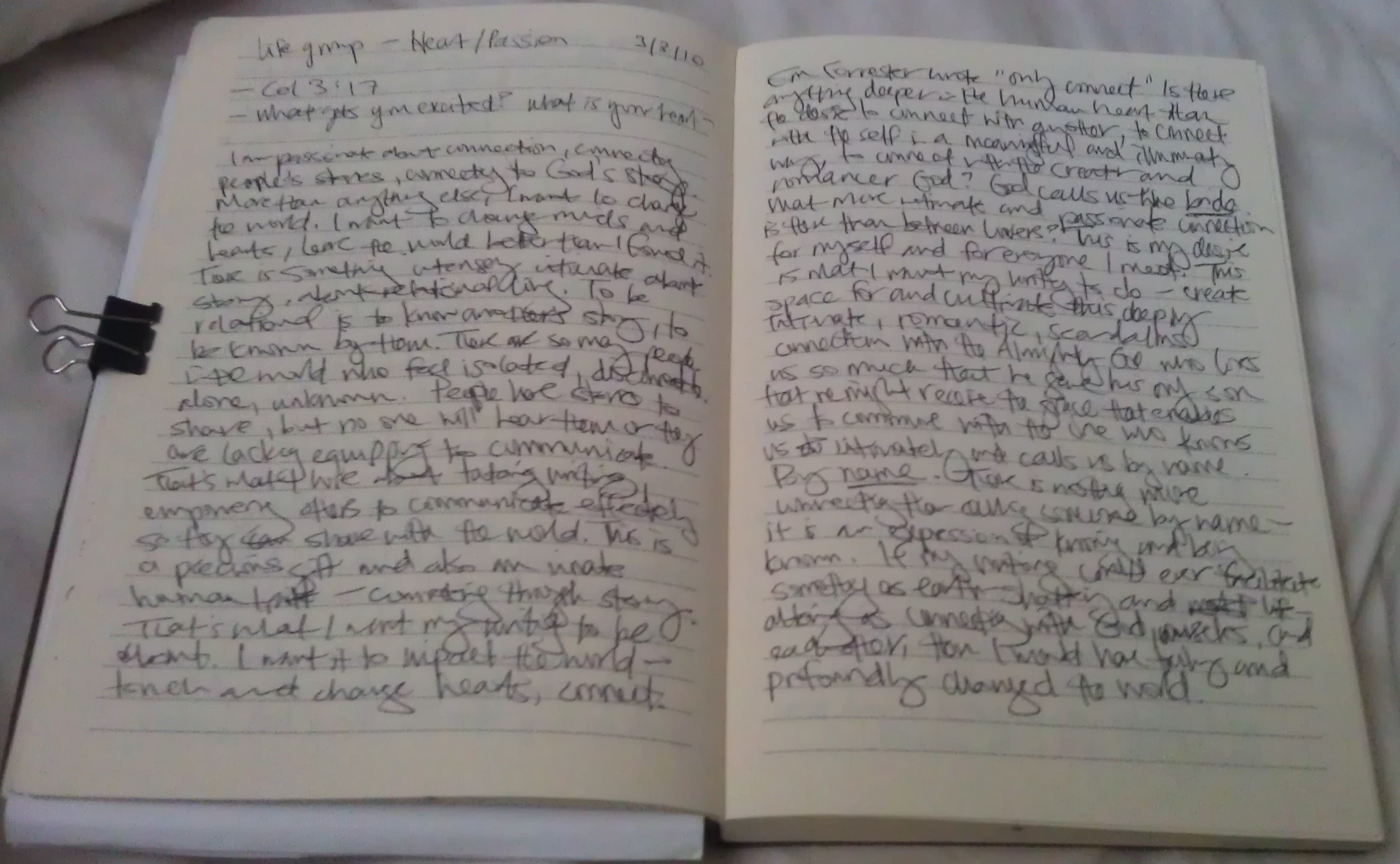 I am passionate about connection, connecting people’s stories, connecting to God’s story. More than anything else, I want to change the world. I want to change minds and hearts, leave the world better than I found it.
There is something intensely intimate about story, about relational living. To be relational is to know another’s story, to be known by them.
There are so many people in the world who feel isolated, disconnected, alone, unknown. People have stories to share, but no one will hear them. Or they lack the proper equipping to communicate well. That’s what I love about tutoring writing: empowering others to communicate effectively so they can share with the world.
This is a precious gift and also an innate human trait, this connecting through story. That’s what I want my writing to be about. I want it to impact the world — touch and change hearts, connect.
E. M. Forrester wrote, “Only connect…” Is there anything deeper in the human heart than the desire to connect with another, to connect with the self in a meaningful and illuminating way, to connect with the creator and romancer God? God calls us the bride. What more intimate and passionate connection is there than between lovers? This is my desire for myself and for everyone I meet.
This is what I want my writing to do: create space for and cultivate this deeply intimate, romantic, scandalous connection with the almighty God who loves us so much that God gave God’s only son that we might receive the grace that enables us to commune with the one who knows us intimately and calls us by name.
By name.
There is nothing more connecting that calling someone by name; it is an expression of knowing and being known.
If my writing could ever facilitate something as earth-shattering and life-altering as connecting with God, ourselves, and each other, then I would have truly and profoundly changed the world.
Balance from the Bookshelf
Hello, lovely readers! Happy Independence Day! I’ve been a little under the weather and haven’t been able to get anything new up on the blog the last few days.
While I’m recovering, I wanted to pass on a few books straight from my very on bookshelf that have inspired, informed and influenced my pursuit of balance — practically, theoretically, intentionally, unintentionally.
Maybe one or two will do the same for you.
Here they are in no particular order:
- The Practice of the Presence of God by Brother Lawrence
- Celebration of Discipline by Richard Foster
- The Rest of God by Mark Buchanan
- Sacred Rhythms by Ruth Haley Barton
- Keeping the Sabbath Wholly by Marva Dawn
- Self Care by Ray Anderson
- Adrenaline and Stress by Dr. Archibald Hart
- Run with the Horses by Eugene Peterson
- Boundaries by Dr. Henry Cloud and Dr. John Townsend
- Wisdom Distilled from the Daily by Joan Chittister
- The Daily Light for Every Day by Anne Graham Lotz
14+ Life Seasons We Balance
Balance is not a new concept. Rather than reinvent the wheel, I’ll let Solomon do the honors:
There is a time for everything,
and a season for every activity under the heavens:2 a time to be born and a time to die,
a time to plant and a time to uproot,
3 a time to kill and a time to heal,
a time to tear down and a time to build,
4 a time to weep and a time to laugh,
a time to mourn and a time to dance,
5 a time to scatter stones and a time to gather them,
a time to embrace and a time to refrain,
6 a time to search and a time to give up,
a time to keep and a time to throw away,
7 a time to tear and a time to mend,
a time to be silent and a time to speak,
8 a time to love and a time to hate,
a time for war and a time for peace.9 What do workers gain from their toil? 10 I have seen the burden God has laid on the human race. 11 He has made everything beautiful in its time. He has also set eternity in the human heart; yet no one can fathom what God has done from beginning to end. 12 I know that there is nothing better for people than to be happy and to do good while they live. 13 That each of them may eat and drink, and find satisfaction in all their toil—this is the gift of God. 14 I know that everything God does will endure forever; nothing can be added to it and nothing taken from it. God does it so that people will fear him.
15 Whatever is has already been,
and what will be has been before;
and God will call the past to account.[a]16 And I saw something else under the sun:
In the place of judgment—wickedness was there,
in the place of justice—wickedness was there.17 I said to myself,
“God will bring into judgment
both the righteous and the wicked,
for there will be a time for every activity,
a time to judge every deed.”18 I also said to myself, “As for human beings, God tests them so that they may see that they are like the animals. 19 Surely the fate of human beings is like that of the animals; the same fate awaits them both: As one dies, so dies the other. All have the same breath[b]; humans have no advantage over animals. Everything is meaningless. 20 All go to the same place; all come from dust, and to dust all return. 21 Who knows if the human spirit rises upward and if the spirit of the animal goes down into the earth?”
22 So I saw that there is nothing better for people than to enjoy their work, because that is their lot. For who can bring them to see what will happen after them?
What season of life are you in? How do you find balance in this season of life?
Share your experience in the comment box below.
Balance is not a tight-rope act
One of the goals of this blog is to keep thinking theologically about how to incorporate and engage the physical body in our mental and spiritual pursuits. This balance is important not only for our spiritual lives but for our lives as a whole.
All things in moderation is a motto I remind myself of often when I indulge in fatty foods, exercise, even watching TV.
Even healthy pursuits can be bad for us in too-large quantities; likewise, less healthy pursuits can be good for us, too, in smaller quantities.
For example, having an alcoholic beverage from time to time can actually be a healthy source of antioxidants. Working out too often or too hard can lead to muscle strains, shin splints, and even dysregulated metabolism.
When we start talking about things like work/school-life balance (for an excellent and thought provoking view, I highly recommend the recently published Why Women Still Can’t Have It All), spirituality-life balance, family-friend balance, conservative-liberal balance, or even productivity-rest balance, we can start to feel like holding everything in perfect tension is an overwhelming and perhaps even impossible task.
Here’s the good news: balance is not a tight-rope act.
Balance is not about taking one painfully tense step after another intensely stressful step on a thin wire above certain death.
Finding balance in life is a lot like contemplative prayer. In contemplative prayer, there is no frustrating struggle for command over distracting thoughts. There is, instead, the honest acknowledgement of the moment and cause of distraction and the disciplined, gentle return to focus on God.
In life, we often expend unnecessary energy beating ourselves up for spending too much time and attention here and not enough there. We struggle and fight and end up in discouraging failure because the truth is we are imperfect people living imperfect lives.
Balance is about extending grace to ourselves in those moments where we step too far to the left or right or when life wears us down and we stop altogether to catch our breath and wipe the sweat out of our eyes.
Body theology is not something to beat ourselves with. It is something to slowly begin to weave into the fabric of our daily lives so that we become
more mindful of the role of our bodies,
more discerning about the messages from the Church and culture,
more aware of injustice, and
more sensitive to the movement of the Spirit within and around us.
I like one lesson Elizabeth Gilbert learns in her memoir Eat, Pray, Love: sometimes we have unbalanced seasons (where one aspect of our lives takes precedence and demands more time and attention while other important aspects may be neglected), but those seasons do not necessarily mean that we cannot have a balanced life.
A work commitment may take priority for a few weeks. A newly married couple may spend more time together than apart as they build the foundation of their marriage. The birth (or death) of a family member may require more emotional energy.
But when these seasons end (and they will), we have the opportunity to return our attention and intention — gently — to the healthy balance of spiritual, mental, and physical engagement in our life’s pursuits.
Balance is not about walking a tight-rope and hoping against hope not to tip or slip and fall.
Balance is about resuming the path toward becoming the healthy, whole people God has created us to be.
All things in moderation, lovely readers. Pace yourselves. Let’s keep walking this path together.
Keeping the Pace

Gibraltar Dam Hike
Yesterday, my husband and I went on another hike, our third day in a row of training for our backpacking trip in August.
If you’re interested in specifics, you can find his account of our hike here.
The trail was what most hikers would consider to be “easy,” but for my poor, out-of-shape body, it was a serious exercise in survival. I even had to break out the trekking poles near the end of the hike because my knee decided to complain a little too loudly.
It was humbling dragging my falling-apart body along next to my husband’s 20-mile-day-hike stamina. But it was also encouraging and inspiring to have him by my side, helping me keep the pace.
Here’s what I learned today:
- Slow and steady wins the race. (An oldie, but a goodie.)
- Shin splints require special stretches. The stretches hurt, but I can actually walk afterwards.
- Gu Chews are not as gross as they sound.
- Staying hydrated requires more forethought and intention when it’s hotter out.
- Hiking is more fun when you hike slowly enough to be able to talk.
- I can actually hike three miles uphill without having to stop if my pace is slow enough and my stride short enough.
- My husband is a brilliant and deep thinker. (Another oldie, but I like being reminded.)
- Bear poop is called scat.
- Steep trails are easier to hike at lower elevations.
- If you hike with your mouth open, you might eat a bug.
As we plodded along the wide, dusty trail (okay, I plodded. My husband strolled.), I started thinking again about Much-Afraid and her journey into the High Places to meet the Good Shepherd on the Mountain of Spices. I thought about how her feet were crippled and how the Good Shepherd sent her with two companions — Sorrow and Suffering — to support her (physically and emotionally) all the way to their destination.
(I know, I think about Hinds Feet on High Places a lot.)
Being in the back country of Santa Barbara with my husband, I realized our hike was a lot like the past few years of my spiritual journey:
- I had to walk my path myself — no one could do the hard work for me.
- I had a destination, but I couldn’t see it when we started and didn’t know what would be required of me before I got there.
- The way laid out for me may not have been the hardest way ever, but I found it challenging.
- I walked with someone who had been there before, knew the way, and had resources I didn’t.
- I did a good job keeping the pace for a while, but after our turn-around point, I got tired and lagged behind or rushed and hurried ahead.
Keeping the pace is one of the hardest tasks for me. It requires all my effort and concentration to live in the middle and stay balanced. I need support and encouragement (and gentle reminders) all along the way, or I revert back to my default mode of rush-lag-rush-lag.
With my spiritual walk, it was my spiritual director who knew the way, who had resources I didn’t, who could see the path in a way I couldn’t, who supported, encouraged, and reminded me to slow-down-but-not-stop, to choose a pace and stride that would sustain me through the whole journey.
With our hike today, it was my husband who knew the way, who had sunscreen and hiking food and extra water, who pointed out the garter snake I nearly stepped on and predicted the elevation gain.
Whether our hikes are physical or spiritual, we benefit from having a companion to walk beside us, share the journey, and continually remind us to keep the pace.
The Spiritual Practice of Hiking
Experienced mountaineers have a quiet, regular, short step — on the level it looks petty; but then this step they keep up, on and on as they ascend, whilst the inexperienced townsman hurries along, and soon has to stop, dead beat with the climb….Such an expert mountaineer, when the thick mists come, halts and camps out under some slight cover brought with him, quietly smoking his pipe, and moving on only when the mist has cleared away….You want to grow in virtue, to serve God, to love Christ? Well, you will grow in and attain to these things if you will make them a slow and sure, an utterly real, a mountain stepplod and ascent, willing to have to camp for weeks or months in spiritual desolation, darkness and emptiness at different stages in your march and growth. All demand for constant light, for ever the best — the best to your own feeling, all attempt at eliminating or minimizing the cross and trial, is so much soft folly and puerile trifling. — Baron Friedrich von Hugel (as quoted in Run with the Horses, Eugene Peterson, p. 109-10)
My husband and I just spent the day in Kings Canyon National Park. Because of my back pain and fatigue issues, this was our first real outside adventure since we moved to Santa Barbara (unless you count snowboarding near Las Vegas in January, during which I stood up a grand total of three times on the bunny slope and quit after the first hour). We want to go backpacking in August, so I need to start getting back into shape after spending the last few months mostly in, on, or near the bed.
Kings Canyon is beautiful, and we were able to enjoy three short, easy hikes in about four hours in the park. For a full account of our journey, visit my husband’s hiking blog here.
All day today, I couldn’t get this quotation (above) out of my head. I am learning to use the “quiet, regular, short step” of the experienced mountaineer.
My husband is constantly reminding me to slow down, pace myself, and enjoy the surroundings, but my destination-oriented brain is solely focused on getting from point A to point B as quickly as possible. I want to be finished, to go back to the car feeling successful. I want to hurryupandgetthere!
I’m the same way in my spiritual life. I want the “fun stuff” of God’s revelation without putting in the time being quiet, being regular, and being well-paced.
This is what I love about centering and contemplative prayer. These practices are a way of entering into the space where we may encounter God, where God may encounter us.
But I’m easily distracted, rushed, irregular. I fill up my days with television and music and talking and all the loudness of life. And when I do set aside time to be still and quiet and experience the presence of God — I want to hurryupandgetthere, too!
But today, in Kings Canyon, we didn’t really have much of a destination at all. The park itself was our destination, and so I was able to enjoy being at the place we wanted to get to, wandering among the meandering paths — paved and unpaved.
For the first time, I was aware of more than just my feet plodding, rushing to the next shaded spot, the crux of the next hill. I was aware of more than just my labored breathing, my annoying allergies, my sciatic nerve.
For the first time, I was able to really look at the mountains and the trees, enjoy the grassy meadows and rivers, feel the mist on my face from the waterfall, notice the smell of pine and cedar on the breeze, look back at my husband and smile.
– Isn’t this great?
For the first time, I was able to appreciate the journey, pace myself appropriately, and experience the healing and renewal that come with just being outside among the sun and shade and surprising beauty.
There’s something about being outdoors that opens us up to natural revelation, to the friendly camaraderie of strangers enjoying a common activity, and to the slow and steady pace and rhythm of a lifelong pursuit of Jesus.
Not a bad way to spend a Sunday.

Zumwalt Meadow Loop

Grizzly Falls

 Holistic Body Theology