Category Archives: Physicality
Holiness, Beauty, and Body Image
How do we engage culture and image and dialogue with truth?
Is there anything holy to be found in our visually driven culture?
If the line between secular and sacred is truly blurred, then how do we bring the holiness of God into our cultural conversations about what is beautiful?
In my own experience, it has been very healing to speak God’s truth into the lies I received from culture about my body image that I believed for so long without even being aware of their influence. This is one reason having a holistic body theology is so important and why I have dedicated my blog to writing about it. We have forgotten who we are. We have forgotten who we have been created to be. Educating people about ways to deconstruct the advertising and entertainment industries can go a long way in bringing truth into cultural light.
Take, for example, Alison Jackson‘s photographs and her discussion of voyeurism in this TedTalk from 2009. In the video she describes how photography seduces us into believing things that aren’t true or into seeing things that we want to be true even when they aren’t possible:
I’m fascinated how what you think is real isn’t necessarily real. The camera can lie, and it makes it very, very easy with the mass bombardment of imagery to tell untruths. (Alison Jackson)
Our consumerist culture buys into nearly anything these days that will feed into the need for instant gratification. Marketing and advertising firms spend their resources on finding out what we wish were true or what we wish we were and then coming up with ways to exploit our wishes by making us feel inadequate, making us feel the need of something we didn’t even know we wanted — and suddenly that need is urgent and insatiable.
In other words, we are driven by fear.
Fear — which is the opposite of faith– and sin — which certainly gets in the way of experiencing God’s holiness — are the roots of many body image issues, especially in our western culture. There is that appealing quality about Gnosticism, for instance, which perpetuates the fear that the body will somehow hinder the soul’s search for enlightenment or perfection or completion. Or that fear of being out of control, which is certainly a known root cause of many eating disorders.
But we were given bodies, and our bodies were pronounced good — a fact we often forget in our effort to retain control.
We need to be reminded that experiencing abundant life necessitates a willingness to release control and by doing so open ourselves up to experience something extraordinary, something unknown, something beautiful — which is the work of the Holy Spirit within us.
Next time you stand in line at the grocery store and stare at all those magazine covers, ask yourself what messages culture is sending you and whether those messages are designed to send you into a spiral of fear and sin or to open you up to the quiet beauty that is the work of the Holy Spirit in our lives.
What cultural messages have you noticed recently? Share your experience in the comment box below. Let’s grow together in our discernment of culture and the media.
Holiness and Beauty: A Meditation
Being an amateur philosopher and a lover of the liberal arts, beauty and aesthetics have always fascinated me. The image of God as Creator, the ultimate source of creativity, has inspired unspeakable awe and wonder. The idea that beauty embodies holiness, or that we may find holiness in the experience of beauty (visually or through the beautiful act or the recognition of beautiful character), sends me back to my undergrad days, reading Socrates and Plato and Aristotle, meditating on the character and mind of God.
God’s holiness is reflected in the beauty of the earth God has created—with just a word! What creative power that Word holds! We, in response, can participate in that holiness when we participate in beauty—enjoying it and creating it.
Consider Isaiah 58:11 and Matthew 6:28-33. What do they tell us about God?
The nature imagery grabs my attention: the well-watered garden, the sun-scorched desert, the splendor of Solomon, the lilies of the field. And then the context of these verses strikes me: Isaiah 58:11 comes as a promise in the midst of fasting, observing the Sabbath, and serving the poor and marginalized. Matthew 6:28 comes in the midst of the sermon on the mount, as Jesus taught his listeners how to live and serve God.
These passages, these promises, require action on our parts. They require response!
Yet they also promise — in the midst of stress, grief, brokenness, doubt, uncertainty about the future — that God will sustain. They promise that whether we bear concerns of finances, employment, community, love, wisdom and discernment, gifts (creative, intellectual, or spiritual), God will provide.
My mind leaps from scripture to scripture.
Psalm 8—what are human beings that God is mindful of us?
Psalm 42—the deer pants for water.
Isaiah 6—the imagery-laden call in God’s throne room.
Revelation 22:17 – all who are thirsty come to the river of life.
1 Kings 10:23-25—an account of Solomon’s glory. Particularly with Solomon, I think it’s interesting that with all we can do and create on our own, with all the glory that Solomon amassed, it cannot hold a candle to the creative word of God that would speak a lily into existence.
God’s creativity and beauty, like God’s holiness, are so wholly other; yet we are made in the image of that creative and beautiful and holy God, and our words contain the power to create as well.
John 15:1-17—the fruit of the vine that results when we abide in the vine that is Jesus. It is from God that we get our creative gifts, but to use them properly and to their full abundance, we must remain attached to the God through whom flows that creative power. That holiness. That holy, holy, holy holiness. Otherwise we are nothing more than Solomon’s glory, amazing for a moment but lost forever after.
Psalm 29 – the beauty of holiness, this is not a new thought! The Israelites understood this deep connection between beauty and holiness, this innate part of God’s glory that must be recognized and responded to. This creativity is what we were created for (Gen 1-2), to bring forth fruit from the earth.
God provides. God sustains. God — by that creative word — speaks life into us, and we in turn are able to speak life into each other, into the world.
What a holy, beautiful truth.
Forward Friday: Prayer for the Rhythm of God
It’s been a busy couple of weeks, and time (and blog writing) got away from me. I’ve missed you lovely readers.
I don’t know about you, but I could use a few moments of stillness in the midst of all the busy-ness this weekend.
Take some time each morning this weekend to still yourself and enter into the rhythm of God. Notice how the prayer exercise below affects your body and your mind. How does it change the way you interact with the rest of your day?
Extra credit: Try this exercise each morning for the next week.
The following prayer exercise is from Body Prayer: The Posture of Intimacy with God by Doub Pagitt and Kathryn Prill (emphasis mine):
…[T]here is a rhythm of God — a rhythm that encompasses life, both the life we can readily see and the unseen life of the spirit. The rhythm of God beckons us, guides us, and dwells in us. When we discover the rhythm of God, we find the heart of God, the dreams of God, the will of God. As those who are created in the image of God, we are endowed with this rhythm. We can find it, step into it, and live in it. This is the kingdom of God — to live in sync with the rhythm of God….
[Pray this prayer aloud.]
The Lord our G0d
Sets our feet in spacious places,
Delivers us from evil,
Has given us freedom with the opening of his hand.
Let us lean into the future before us,
Let us follow the Way.Prayer Posture
Begin by standing with your feet together and your arms hanging at your sides. With either your left or right foot, lunge forward far enough to feel the stretch in your thigh. If you can, lower the thigh of the leg in front to create a ninety-degree angle in the bend of your knee. Switch legs after a while if you need to. Feel the rhythm of God in your muscles as they strain, in your legs as you switch positions, in your breathing, and in the breathing and sounds of those around you [if you choose to try this prayer exercise in a group setting]. As you let the rhythm created in the room around you expand in your mind, consider how the rhythm of God is all around us.
Next week we will do some theological and spiritual reflection on Compassion: A Reflection on the Christian Life by Henri Nouwen, Donald McNeill, and Douglas Morrison. Until then, lovely readers, may the peace of God be on you all.
Trust and Body Theology: what my husband taught me about God
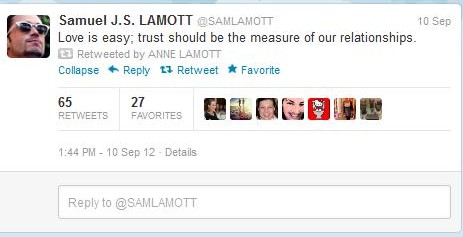 I saw this tweet last week on Anne Lamott’s feed, and I got to thinking.
In grad school, I took a class called Marriage and Interpersonal Relationships in which the professor talked about how people at bottom have either struggles with shame or trust issues. Everyone has a little of both, but either shame or trust is the key component in why we think the way we think, why we act the way we act, and why we end up in the conflict cycles in relationships that we end up in.
After a lot of soul-searching (and a paper we had to write), I finally came to the conclusion that I am a trust-issue person. Somehow, being a shame-issue person seemed better or easier to admit, but when I finally realized the truth about my own woundedness, I began to take steps toward my healing.
I did a lot of work on myself after that, which took years. I remember something a close friend once said about the healing she experienced in her life (as a shame-issue person). She said that the final healing came from her husband.
That’s what I thought of when I read that tweet the other day. I thought about all the work I did to undo the learning I had learned growing up that no one was trustworthy and that I had to take care of everything myself. I thought about all the work I did to learn to do more than say the words with my mouth that God is trustworthy; I also had to believe it in my heart.
But at the end of the day, the final healing came from my relationship with my husband.
When I read that tweet, I thought about how I trust my husband implicitly and completely without the slightest twinge of doubt, suspicion, or jealousy. If he says he’s working late, I know that means he is. If he chats on Facebook with an old girlfriend, I know they really are just friends. I know because every single day since the day we met he has proven with his behavior that I can trust him. I know because even when some embarrassingly irrational fear emerged while we were dating, and I acted out, he said the words I needed him to say and behaved the way I needed him to behave to prove to me again that I can trust him. I know because if he could see the irrational, embarrassing side of me with all the woundedness still left unhealed and still want to date me and marry me and love me forever, he was worthy of my trust.
And it made me think about God, too, and how hard it is for me to trust God. It’s easy to love God, serve God, praise God. But trust? For some people, believing that God loves them, that they are love-able, is the hardest thing. For me, believing God is trustworthy (especially believing that I don’t have to earn it) is the hardest thing. I’ve been slowly healing from this great lie I believed for years, but the final healing came from my husband.
My aunt once said, famously, that sometimes we just want someone with skin on. Sometimes, no matter how many Bible verses we memorize or how much theology we learn about who God is and who we are, we just can’t accept the truth until we receive it from someone with skin on.
That is the beauty of the incarnation. God poured all of that majesty and might and holiness and completeness and divinity into one small, simple, ordinary human being. After everything we had learned, after all our God-encounters throughout history, we just couldn’t get it until we actually saw, felt, heard, and sat at the feet of someone with skin on.
That’s how we’re made.
If my husband — a fallible human being just like I am — can be this honest, this dependable, this trustworthy, then SURELY how much more so is the God we love and serve and praise?
I’m no fool. I don’t expect my husband to be perfect. I know he is not God. I know he will let me down, hurt me, disappoint me, and maybe even betray my trust in him one day. But through his physical presence in my life, I have been able to experience the truth about who God is. All the Bible verses in the world couldn’t do that.
That is body theology.
Forward Friday: Are you more physical or digital?
Are you more invested in your physical reality or in digital experience?
This week we considered the possible future of the Church and of body theology as we become more and more invested in digital community.
This weekend, take the opportunity to assess your priorities. Where are you investing your time and energy?
Try the following exercise:

Here’s an example.
1) Take a piece of paper and draw a line down the middle of the page, from top to bottom. On the left side, write PHYSICAL. On the right side, write DIGITAL.
2) Throughout the weekend, log the type and duration of your activities. Anything that plants you firmly in the physical world, write on the left side. Anything involving digital community, write on the right side.
3) At the end of the weekend, tally up your time spent on each side of the page. Which side receives more of your attention and investment?
4) Reflect on the results of your exercise. Are you pleased with the choices you made over the weekend? Does the amount of time spent accurately reflect the priorities you thought you had? Did you discover anything new about yourself?
Guest Post: The Future of Church
I’m extremely proud and grateful to host a guest post from my wonderful, brilliant husband, Matt Cavanaugh. In addition to the privilege of being married to me, Matt is a musical composer, avid hiker, and lover of all things REI. He holds a masters in Worship, Theology, and Art from Fuller Seminary as well as undergraduate degrees in psychology, theology, and church and ministry leadership from Trinity Christian College in Palos Heights, IL. Find more from Matt at his website.

God created us each with purpose in mind. It could be purpose as in singular or purposes as in plural. But we’ve been created with — what I believe scripture would support — a ton of intention. (Is there a person who has read Jeremiah out there who can give me an “Amen”?) Not only do we have a purposeful existence, but we also have a purposeful time and location.
I believe that we are living at a very important point in Church history. We’re coming out of the Seeker/Modernist movement and a shorter but important Emergent/Postmodern movement… and now we’re in what I’d consider an idling spot. If we are talking about cars, we have our car still on but at a red light, awaiting a green to move forward and go to the next place.
And so I ask… what is this next spot? This next movement/evolution/step?
Is it the pendulum swinging back towards the more conservative movement (ala Neo-Reformists like Piper, Driscoll, etc…)?
Or is it more progressive?
Or, to think more multidimensionally, is it not a question of more liberal/more conservative or progressive/regressive but instead an entire paradigm shift?
God created us at turning point, and I believe that each of us has a role that requires our integrity and intention. God’s purposes are great for Creation; I believe that (and hope you do too!), and we have been invited to play a part in this wonderful drama of God’s world.
What is your role? I’m not necessarily talking Strengthfinders 2.0 or Myers-Briggs but instead your ROLE. How is/will God use you to further the growth and development of the Kingdom? How will your existence be important to the further unveiling of God’s heart and Plan? (This is not rhetorical… I really would love to hear your answers!)
What might be God moving us towards next?
I have a feeling that the next movement will have to do less with theology and more with physical and emotional socialization. Our world is becoming more isolated physically but more social in a digital sense. I anticipate seeing this trend further, where church (and The Church) is becoming more about what is convenient for our busy schedules. I anticipate people’s spending less time in chapels and more at home with virtual socialization. Maybe someone will figure out a way to create increased digital social community, more developed and fulfilling than what we have already.
How would this more digital and physically isolated experience of the community of God affect our body theology?
Regardless of what the future holds, know this: You have purpose. I have purpose. God is purposeful. Let’s be intentional as we play our part in the future of Church.
Forward Friday: Finding God in the Physical
This week we talked about how I learned to find God not in the voice in my head but in the voice of a thousand mundane, ordinary, regular, unexceptional, physical things that mean that I’m ALIVE and DOING something outside in the world with other people.
This weekend, take some time to reflect on the past week, month, or year of your life. You could journal, go for a walk, or share with a friend.
When did you feel most connected to God?
What activities, events, or movements created space for that connection to take place?
Were you in your head or in your physical reality?
If you’re having trouble getting started, I highly recommend Miles to Run Before We Sleep: Step-by-Step Meditations and Reflections toward a Life of Persevering, Risk-taking, Justice, Mercy, and Humility by Tim Hoekstra.
Tim has an amazing ministry and life story to share, and my husband and I were very honored to have been married by him last April. I’m excited to start Tim’s devotional this weekend and may be sharing some insights here in the coming weeks.
…and we’re back!
My August “pause and quietly think about” turned out to be more of a “work like crazy for three weeks and then go on a road trip.” I didn’t get as much time for silence and reflection as I had planned, but what I did get was a whole seven total days without one single moment of work.

Todd Lake, Oregon
copyrighted
My husband and I drove almost 3,000 miles on our road trip through central California, northern California and Oregon, went on one backpacking trip (one night), enjoyed seven different hikes (eight if you count walking along the smoky rim of Crater Lake), stayed in four different hotels, and visited with two sets of Oregonian friends — transplants from Chicago.
My brain got a glorious break from all the rushing and working and pushing and preparing I squeezed into three weeks before our trip.
But my body — oh my!
Here’s the thing I like about body theology. Since I first heard the term, sitting in that little third-floor classroom at Fuller Seminary about midway through my program, my world has opened up. I have been pushed and stretched and challenged to think about my body, my SELF, as part of my theology, as a full participant in the spiritual encounter of God in my life.
The thing I like about body theology is that it keeps me grounded. It reminds me that the ordinary, the physical, the tangible, the real, the messy, the mundane, the accessible — this is all part of how we were created to experience the fullness of life and completion of joy that we have been promised.
Theology seems like a heady, ethereal, intellectual, intangible mist that we grasp for but can never really, fully reach. Theology is such an distant, academic word.
But body theology brings all that misty intangibility into focus, gives it form, makes it grasp-able in the most literal sense. Body theology is something we can hold onto.

Weaver Lake, Sequoya National Forest, California
copyrighted
As Matt and I hiked up and down mountains, slept in tents, wandered behind waterfalls, slogged through flooded meadows, drove miles and miles and miles (and even through a tree!), I wasn’t having intellectual epiphanies about my spiritual life or about God.
I was using my muscles.
I was pushing myself uphill till I nearly had an asthma attack.
I was lugging a too-large, half-empty backpack I borrowed.
I was squirming in the passenger seat.
I was being lulled to sleep by the motion of the car as the miles peeled away under our speeding bodies.
I was alternately pushing sleeping-Matt and getting pushed by sleeping-Matt out of the too-small beds in our cheap motels.
I was racing the sundown to the top of a mountain.
I was stretching my sore legs and eating breakfast for lunch and snapping an unmanageable amount of digital photos and listening to a good book being read badly on audio CD and enjoying being on vacation with my husband and hanging out with his Chicago-to-Oregon friends and blowing my dripping nose on wads of toilet paper as we hiked under tall pines and complaining that my back was killing me and massaging my husband’s neck as we drove and a thousand other mundane, ordinary, regular, unexceptional, physical things that mean that I’m ALIVE and DOING something outside in the world with other people.
It’s easy to live in my head because I work from home and have very limited community in a town we are still adjusting to living in after just over a year of settling in. It’s easy to live in my head because I’m an introvert and a writer and prefer digital communication over picking up a phone.
Mostly it’s easy to live in my head because there is still a part of me that believes that in my head is where I will meet God, where I will mentally understand and logically decide and cognitively interact with the intangible-spirit-being that I grew up loving and seeking and learning to find with my mind. Faith seeking understanding.
That part of me is still pretty big and loud and commanding of much of my time and energy. But the part of me that is small and quiet and unassuming, the part of me that gives instead of takes, the part of me that is learning to rest and be instead of work and do, that part of me — the part that woke up the day I first heard about body theology in that little third-floor classroom — that part of me found its voice this past week in the mundane and ordinary, in the exercise and outdoors and movement from place to place.
That voice isn’t as loud or commanding as the voice of my head. But oh, how it sings!
An August of Selah
Hello, lovely readers! It’s been about six months since I began blogging regularly here at Holistic Body Theology, and I’ve decided to take the month of August off from blogging and dedicate the time to praying, planning, and preparing for the future of the blog.
Although I won’t be posting anything new, I’ll still be around, so feel free to connect with me and let me know what you’d like to see here in the future. Leave a comment in the box below, or hit me up on Facebook or by email. I would love to hear from you.
In the meantime, here are some of the most popular posts from the past few months to tide you over until I get back.
Sex is Good, Even When You’re Not Having Any
Reflections on Body Theology: 10 Things that Annoy Me about Being a Woman
Choosing Church: A Lament (Part 1)
Conversation: Are You an Ender or a Starter?
Bathtub Spirituality: Getting Naked Before God
Gender-Inclusive Language; Gender-Inclusive God – Part 1
The Spiritual Practice of Sleeping
See you all in September!

 Holistic Body Theology