Category Archives: Community
Guest Post: The Future of Church
I’m extremely proud and grateful to host a guest post from my wonderful, brilliant husband, Matt Cavanaugh. In addition to the privilege of being married to me, Matt is a musical composer, avid hiker, and lover of all things REI. He holds a masters in Worship, Theology, and Art from Fuller Seminary as well as undergraduate degrees in psychology, theology, and church and ministry leadership from Trinity Christian College in Palos Heights, IL. Find more from Matt at his website.

God created us each with purpose in mind. It could be purpose as in singular or purposes as in plural. But we’ve been created with — what I believe scripture would support — a ton of intention. (Is there a person who has read Jeremiah out there who can give me an “Amen”?) Not only do we have a purposeful existence, but we also have a purposeful time and location.
I believe that we are living at a very important point in Church history. We’re coming out of the Seeker/Modernist movement and a shorter but important Emergent/Postmodern movement… and now we’re in what I’d consider an idling spot. If we are talking about cars, we have our car still on but at a red light, awaiting a green to move forward and go to the next place.
And so I ask… what is this next spot? This next movement/evolution/step?
Is it the pendulum swinging back towards the more conservative movement (ala Neo-Reformists like Piper, Driscoll, etc…)?
Or is it more progressive?
Or, to think more multidimensionally, is it not a question of more liberal/more conservative or progressive/regressive but instead an entire paradigm shift?
God created us at turning point, and I believe that each of us has a role that requires our integrity and intention. God’s purposes are great for Creation; I believe that (and hope you do too!), and we have been invited to play a part in this wonderful drama of God’s world.
What is your role? I’m not necessarily talking Strengthfinders 2.0 or Myers-Briggs but instead your ROLE. How is/will God use you to further the growth and development of the Kingdom? How will your existence be important to the further unveiling of God’s heart and Plan? (This is not rhetorical… I really would love to hear your answers!)
What might be God moving us towards next?
I have a feeling that the next movement will have to do less with theology and more with physical and emotional socialization. Our world is becoming more isolated physically but more social in a digital sense. I anticipate seeing this trend further, where church (and The Church) is becoming more about what is convenient for our busy schedules. I anticipate people’s spending less time in chapels and more at home with virtual socialization. Maybe someone will figure out a way to create increased digital social community, more developed and fulfilling than what we have already.
How would this more digital and physically isolated experience of the community of God affect our body theology?
Regardless of what the future holds, know this: You have purpose. I have purpose. God is purposeful. Let’s be intentional as we play our part in the future of Church.
An August of Selah
Hello, lovely readers! It’s been about six months since I began blogging regularly here at Holistic Body Theology, and I’ve decided to take the month of August off from blogging and dedicate the time to praying, planning, and preparing for the future of the blog.
Although I won’t be posting anything new, I’ll still be around, so feel free to connect with me and let me know what you’d like to see here in the future. Leave a comment in the box below, or hit me up on Facebook or by email. I would love to hear from you.
In the meantime, here are some of the most popular posts from the past few months to tide you over until I get back.
Sex is Good, Even When You’re Not Having Any
Reflections on Body Theology: 10 Things that Annoy Me about Being a Woman
Choosing Church: A Lament (Part 1)
Conversation: Are You an Ender or a Starter?
Bathtub Spirituality: Getting Naked Before God
Gender-Inclusive Language; Gender-Inclusive God – Part 1
The Spiritual Practice of Sleeping
See you all in September!
The Habit of Hospitality
People are creatures of habit. We like to be comfortable and content. We like met expectations. We like sameness.
But Christ did not call us to comfort and contentment, sameness or habit. We are called to more than the status quo, more than what is easy and accessible.
We are called to go. We are called to give up. We are called to drop and follow. We are called to run. We are called to be bold. We are called to be counter-cultural. We are called to be subversive. We are called to live in tension, in paradox. We are called to more.
Since moving to a new area and starting over again to find a community to participate in, my husband and I have been reminded — at times quite painfully — what it’s like to be new, outside, uninitiated. In the past year, here are three key ingredients I’ve discovered in true hospitality.
1) Be genuine.
Even the less-discerning among us can spot a faker a mile away. The smile a little too forced. The voice a little too high. The questions that don’t wait for an answer. The slimy feeling left behind — sticky-sweet, I call it, the kind of hospitality that leaves a residue. If we want people to feel welcomed, we have to be genuinely welcoming.
2) Be the initiator and the pursuer.
Simply put, follow up. New people have already made the first move by showing up. Make them feel genuinely welcomed by inviting them out for coffee, texting them to ask about their day, Facebooking them a funny video that reminded you of your recent conversation. Do something honest and tailored, something that allows for a response. Do it more than once. No form letters or cold calls allowed.
3) Earn the right to ask personal questions.
Everyone hates small talk, but going zero to sixty can make newcomers feel uncomfortable and caught off-guard. Don’t ask a question you wouldn’t be willing to answer yourself. Take time to build relationship with people. Let depth come naturally. Create space for deep conversation, make the first move, and allow them to share when they’re ready — when you’ve earned their trust.
I’m the first to admit I’m not the person most suited to hospitality. As an introvert, I tend to make terrible first impressions and usually only slightly less terrible second and third impressions. It takes time for me to open up to new people. On the rare occasion I work up the courage to initiate, the experience is generally monumentally awkward for everyone involved. (Hence my failure at working retail.)
I know how hard it can be to be willing to be uncomfortable, to be the one to break the ice, to leave the circle of familiar friends and open up to someone new. But this past year, being the newcomer at every new church service, every new community event, I have been reminded that it is infinitely more difficult to be on the outside, feeling displaced and excluded — maybe even unwanted.
Next time I’m on the end of extending hospitality to someone new, I will remember to be in the habit of being genuine, following up, and earning the right to go deeper.
What’s your hospitality story?
Forward Friday: On the Act
On Monday we talked about the act of writing it down and on Wednesday about the act of creating art. This weekend, take some time to explore your spirituality and personal growth in a tangible way.

All my journals from the past six years, except one or two I can’t find!
Here are some ideas to get you started:
- write it down in a journal
- create a collage
- create a mural
- paint
- write it on a t-shirt and wear it
- use play dough
- draw a picture
- take pictures
- carve or sculpt
- choreograph and perform a dance
- write and record a song
- finger paint
Come back and share about your experience in the comment box below. I’d love to see what you create!
On the Act of Creating Art
On Monday we talked about how something happens when we put tangible words on a tangible page, connecting the physical with the mental and spiritual. But not everyone is inspired by words alone. Sometimes we need something even more tangible, even more physical.
I don’t pretend to be an artist. I know I am severely lacking in this area and choose to surround myself with artists to make up for my disability. However, in the spirit of friendship with you lovely readers, I will share one of my poor attempts at collage — just to prove that sometimes it is simply the act of creating something physical even more than the finished product that affects us emotionally and spiritually.
The finished product below may not affect anyone else, but the act of creating it for me was a quite profound experience of emotional and spiritual breakthrough.
I’ll even tell you why.
In the act of creating this silly little collage out of scraps from a friend’s art box, I was able for the first time to fully accept myself as a physical being, with all my particular flaws and traits.
This is a piece of my story, from one of my journals, created my by own hand amongst friends on April 18th, 2009.
On the Act of Writing It Down
Something happens when we put words on paper with pen and ink. There is something deeper and more real about forming the letters with our own hands, producing something tangible and lasting. For all the many, many buttons I have pushed to put my intangible thoughts on the digital page, nothing quite captures the something that happens when we truly write the words. This, too, is body theology.
From one of my journals…written in my own hand with pen and ink while amongst friends on March 3, 2010.
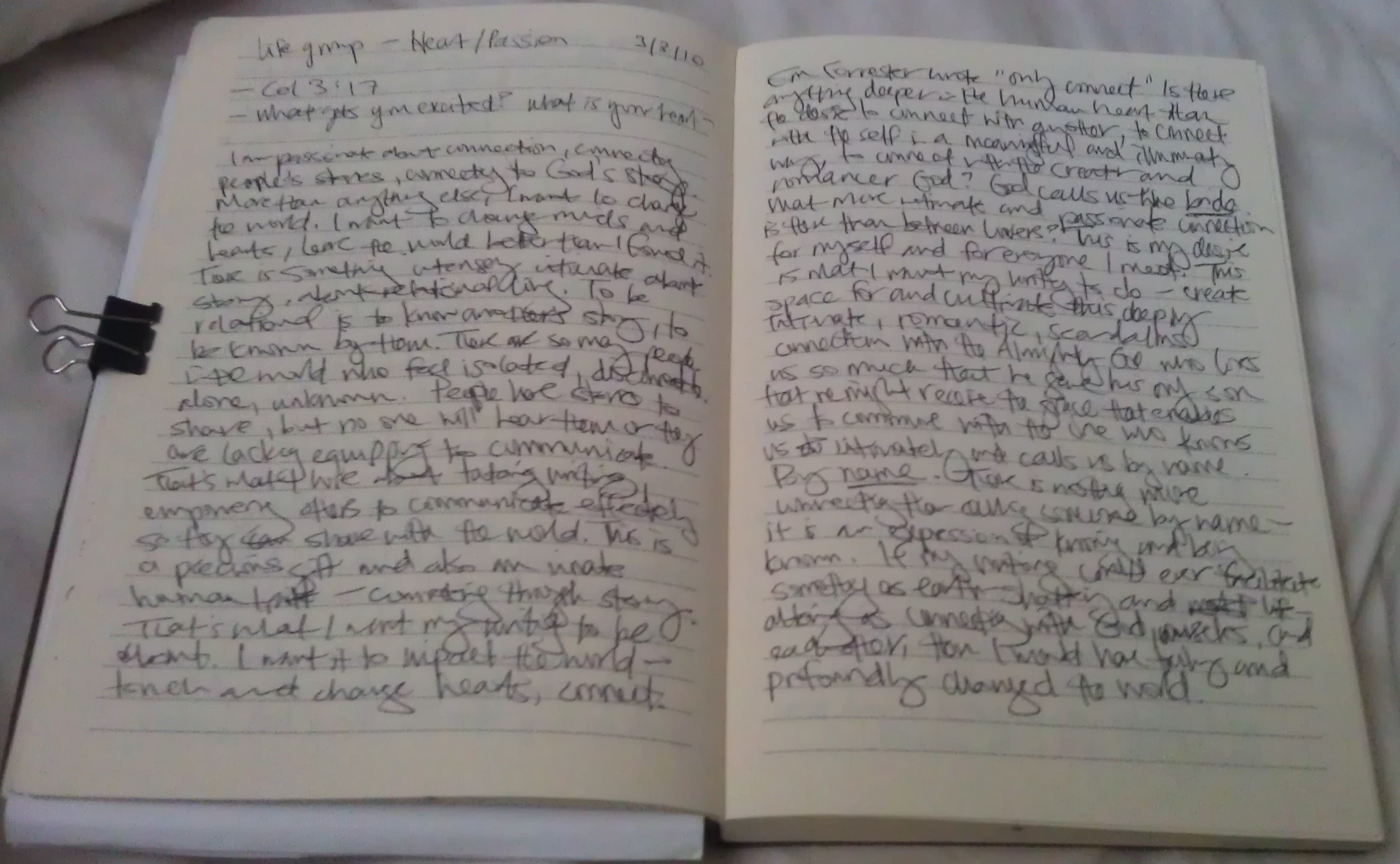 I am passionate about connection, connecting people’s stories, connecting to God’s story. More than anything else, I want to change the world. I want to change minds and hearts, leave the world better than I found it.
There is something intensely intimate about story, about relational living. To be relational is to know another’s story, to be known by them.
There are so many people in the world who feel isolated, disconnected, alone, unknown. People have stories to share, but no one will hear them. Or they lack the proper equipping to communicate well. That’s what I love about tutoring writing: empowering others to communicate effectively so they can share with the world.
This is a precious gift and also an innate human trait, this connecting through story. That’s what I want my writing to be about. I want it to impact the world — touch and change hearts, connect.
E. M. Forrester wrote, “Only connect…” Is there anything deeper in the human heart than the desire to connect with another, to connect with the self in a meaningful and illuminating way, to connect with the creator and romancer God? God calls us the bride. What more intimate and passionate connection is there than between lovers? This is my desire for myself and for everyone I meet.
This is what I want my writing to do: create space for and cultivate this deeply intimate, romantic, scandalous connection with the almighty God who loves us so much that God gave God’s only son that we might receive the grace that enables us to commune with the one who knows us intimately and calls us by name.
By name.
There is nothing more connecting that calling someone by name; it is an expression of knowing and being known.
If my writing could ever facilitate something as earth-shattering and life-altering as connecting with God, ourselves, and each other, then I would have truly and profoundly changed the world.
Forward Friday: What does God value?
This week we’ve been talking about church plants and what it looks like to be the community of God. For the weekend, try this short journal exercise:
Ask yourself: what does God value? How can the community of God be and behave more according to God’s values and goals for the body of Christ?
Not into journaling? Try discussing the question over coffee or tea with a friend.
Come back and share your experience in the comment box below.
What would it look like?
What would it look like if church communities sat down every month and had a Kaizen meeting? What if we constantly asked ourselves what God values and how to usher in the kingdom of God?
What would it look like if we not only allowed church plants to be new and different — to behave newly and differently — but also expected it? Go forth and be new wine skins.
What if we viewed church communities as organisms, not as organizations? Living, breathing, growing, changing entities with lifespans and families and personalities and the freedom to try, to surpass, to surprise.
What would that look like?
What if we started by asking what God is already doing and how to join in instead of asking God to sign on to our next big idea? See the new thing springing up and enter in!
What if we refused to programmize, institutionalize, or bureaucratize? What if the church community didn’t need accountants and buildings and budgets? What if we focused more on being available than on being established?
What if “preacher” were not automatically synonymous with “leader?” What if our leadership were flat? What if it were equal?
What would that look like?
What if we worried more about being mobile than being mega?
What if we did not pursue the praise of people but the principles of the kingdom of God?
What if we were innovators and creators and deconstructors and reconstructors and philosophers and activists and lovers and monks and healers?
What if we were loud? What if we were quiet? What if we were brave?
Who would we look like?
15 Benefits of Being a New Church Plant
- You don’t think you have everything figured out yet.
- You don’t feel the need to run everything like a well-oiled machine.
- You don’t have any parking spaces labeled “senior pastor only.”
- You are still small enough that you recognize a new face.
- You are tight enough that most of the participants feel like family.
- You can recognize your mistakes as mistakes.
- You can admit your mistakes and move on.
- You’re more willing to try new (or really old) things.
- You’re more likely to keep/enjoy/benefit from the new (or really old) things that you try.
- You have to ask for help more often.
- You get to help/volunteer/participate more often.
- You feel more ownership and buy-in because you are helping/volunteering/participating.
- You worry less about who you might offend or what unspoken rules you might break.
- You worry less about starting new programs.
- You worry more about identifying what God is already doing and how to enter into it.

Image courtesy of FreeDigitalPhotos.net
Forward Friday: Relational Living
Wednesday, I wrote about my purpose in blogging on Holistic Body Theology. I shared that I write this blog because we are not made to be alone. We do not walk this journey alone.
Relational living is a simple, yet vital, element of body theology. This weekend, as you spend time with family, friends, maybe a church community, take the opportunity to be mindful of the way God created us to be together.
Then come back and share your experience in the comment box below.
How did you participate in the body of Christ this weekend?

 Holistic Body Theology