Category Archives: Incarnation of Christ
The Compassionate God
This week, we are reading through Compassion: A Reflection on the Christian Life by Henri Nouwen, Donald McNeill, and Douglas Morrison.
Introduction & Part One: The Compassionate God
To be compassionate then means to be kind and gentle to those who get hurt by competition. (6)
But being compassionate toward others, especially the poor and marginalized to whom competition does the most harm, does not come naturally. We do not like to be around others’ pain and suffering, and we certainly do not like to give up anything we consider ours for the benefit of someone else — even in the name of fairness and justice, much less forgiveness and compassion.
Fortunately, we are not governed by our own desires and fears but by the movement of God in our lives:
God’s own compassion constitutes the basis and source of our compassion….[I]t is only in discipleship that we can begin to understand the call to be compassionate as our loving God is compassionate….[I]t is through these disciplines [of prayer and action], which guide our relationships with God and our fellow human beings, that God’s compassion can manifest itself. (8)
Their central argument is that Christians — as human beings who are by our very nature threatened by the idea of showing compassion to others (and thereby losing competition and identity) — are enabled to share in God’s compassion through the new identity we have been given as a result of our experience of the compassion of God in our lives through the incarnation, death and resurrection of Jesus Christ.
This means the compassion that moves us to “be kind and gentle to those who get hurt by competition” does not come from our own nature; it comes from God.
It also comes from the example of a God who would make himself nothing by taking the very nature of a servant, being made in human likeness. Because of the humble incarnation of Christ, the example of Jesus’ life, the choice to be obedient to death, and the miracle of the resurrection, we are able to experience the compassion of God for ourselves:
Jesus who is divine lives our broken humanity not as a curse…, but as a blessing. His divine compassion makes it possible for us to face our sinful selves, because it transforms our broken human condition from a cause of despair into a source of hope. (15)
The mystery of God’s love is not that our pain is taken away, but that God first wants to share that pain with us. (16)
Once we have experienced God’s compassion in our own lives, we are transformed by this new-found grace and freedom to live into the new identity we are given as children of God. Then we are able to follow the example of Jesus. Indeed, we are called to do so:
[O]nce we see that Jesus reveals to us, in his radically downward pull, the compassionate nature of God, we begin to understand that to follow Jesus is to participate in the ongoing self-revelation of God. (27)
Personally, this is where I get stuck. I can agree all day that Jesus taught us to be servants and showed us by example how to live radically counter-cultural lives that defy competition in favor of compassion and justice for the poor and marginalized.
But what does that look like in my life? Am I missing out on the will of God by not living in Calcutta or joining Shane Claiborne’s intentional community? What does it mean to be radically counter-cultural?
Radical servanthood is not an enterprise in which we try to surround ourselves with as much misery as possible, but a joyful way of life in which our eyes are opened to the vision of the true God who chose to be revealed in servanthood….[S]ervice is an expression of the search for God. (29)
That’s a beautiful line: a joyful way of life in which our eyes are opened to the vision of the true God who chose to be revealed in servanthood.
It’s not about finding the most misery. We don’t all have to be Mother Theresa to be doing God’s compassionate work in the world. It’s about a radical paradigm shift. It’s about seeing with new eyes, eyes opened to who God is through service.
So how do we know what we are called to do in the world? How do we know if we are Mother Theresas or mothers of three? Our wise authors remind us that it’s much simpler than we imagine:
The obedience of Jesus is hearing God’s loving word and responding to it. (34)
We are poor listeners because we are afraid that there is something other than love in God….[Jesus] came to include us in his divine obedience. He wanted to lead us to God so that we could enjoy the same intimacy he did. (38)
God is all about relationship. God is all about intimacy. When we relate to God intimately, we cannot help but see the world with new eyes. We cannot help but be moved by compassion. We cannot help but pray and act — those disciplines that guide our relationships with God and others.
On Wednesday, we’ll look at Part Two: The Compassionate Life.
Trust and Body Theology: what my husband taught me about God
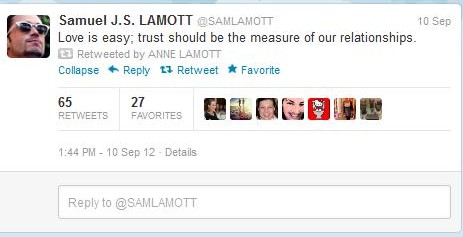 I saw this tweet last week on Anne Lamott’s feed, and I got to thinking.
In grad school, I took a class called Marriage and Interpersonal Relationships in which the professor talked about how people at bottom have either struggles with shame or trust issues. Everyone has a little of both, but either shame or trust is the key component in why we think the way we think, why we act the way we act, and why we end up in the conflict cycles in relationships that we end up in.
After a lot of soul-searching (and a paper we had to write), I finally came to the conclusion that I am a trust-issue person. Somehow, being a shame-issue person seemed better or easier to admit, but when I finally realized the truth about my own woundedness, I began to take steps toward my healing.
I did a lot of work on myself after that, which took years. I remember something a close friend once said about the healing she experienced in her life (as a shame-issue person). She said that the final healing came from her husband.
That’s what I thought of when I read that tweet the other day. I thought about all the work I did to undo the learning I had learned growing up that no one was trustworthy and that I had to take care of everything myself. I thought about all the work I did to learn to do more than say the words with my mouth that God is trustworthy; I also had to believe it in my heart.
But at the end of the day, the final healing came from my relationship with my husband.
When I read that tweet, I thought about how I trust my husband implicitly and completely without the slightest twinge of doubt, suspicion, or jealousy. If he says he’s working late, I know that means he is. If he chats on Facebook with an old girlfriend, I know they really are just friends. I know because every single day since the day we met he has proven with his behavior that I can trust him. I know because even when some embarrassingly irrational fear emerged while we were dating, and I acted out, he said the words I needed him to say and behaved the way I needed him to behave to prove to me again that I can trust him. I know because if he could see the irrational, embarrassing side of me with all the woundedness still left unhealed and still want to date me and marry me and love me forever, he was worthy of my trust.
And it made me think about God, too, and how hard it is for me to trust God. It’s easy to love God, serve God, praise God. But trust? For some people, believing that God loves them, that they are love-able, is the hardest thing. For me, believing God is trustworthy (especially believing that I don’t have to earn it) is the hardest thing. I’ve been slowly healing from this great lie I believed for years, but the final healing came from my husband.
My aunt once said, famously, that sometimes we just want someone with skin on. Sometimes, no matter how many Bible verses we memorize or how much theology we learn about who God is and who we are, we just can’t accept the truth until we receive it from someone with skin on.
That is the beauty of the incarnation. God poured all of that majesty and might and holiness and completeness and divinity into one small, simple, ordinary human being. After everything we had learned, after all our God-encounters throughout history, we just couldn’t get it until we actually saw, felt, heard, and sat at the feet of someone with skin on.
That’s how we’re made.
If my husband — a fallible human being just like I am — can be this honest, this dependable, this trustworthy, then SURELY how much more so is the God we love and serve and praise?
I’m no fool. I don’t expect my husband to be perfect. I know he is not God. I know he will let me down, hurt me, disappoint me, and maybe even betray my trust in him one day. But through his physical presence in my life, I have been able to experience the truth about who God is. All the Bible verses in the world couldn’t do that.
That is body theology.
An August of Selah
Hello, lovely readers! It’s been about six months since I began blogging regularly here at Holistic Body Theology, and I’ve decided to take the month of August off from blogging and dedicate the time to praying, planning, and preparing for the future of the blog.
Although I won’t be posting anything new, I’ll still be around, so feel free to connect with me and let me know what you’d like to see here in the future. Leave a comment in the box below, or hit me up on Facebook or by email. I would love to hear from you.
In the meantime, here are some of the most popular posts from the past few months to tide you over until I get back.
Sex is Good, Even When You’re Not Having Any
Reflections on Body Theology: 10 Things that Annoy Me about Being a Woman
Choosing Church: A Lament (Part 1)
Conversation: Are You an Ender or a Starter?
Bathtub Spirituality: Getting Naked Before God
Gender-Inclusive Language; Gender-Inclusive God – Part 1
The Spiritual Practice of Sleeping
See you all in September!
Forward Friday: What the Story of God Means
One of the most significant elements in body theology is the actual, physical life, death, and resurrection of Jesus. That’s why Christmas, Holy Week, and Easter Sunday are so pivotal. We Christians are who we are because of who Christ is and what Christ did for us. Sometimes looking at the big picture of the course of biblical history can help us understand what brings us to this moment of Christ’s preparation for death.
As you celebrate Good Friday, Holy Saturday, and Easter Sunday this weekend, read back over some of the key elements of the story of God from our little flash Bible course this week to dig into the significance of what we are about to celebrate. What stands out as particularly meaningful to you? Let me know in the comment box below.
1. God takes evening walks with Adam and Eve in the garden.
2. Becoming aware of their nakedness and feeling ashamed causes them to hide from God.
3. God’s people become afraid of God and ask Moses to speak to God on their behalf.
4. God’s people are afraid even of the glory of God reflected on Moses’ face, so he has to wear a veil until the glory fades.
5. God instructs the people to build the Ark of the Covenant, where God’s presence will be confined among them.
6. The people never touch or open the Ark of the Covenant because it is so holy.
7. The Ark lives in its own tent among them, called the Tabernacle, where the people come to worship God.
8. After Moses, God speaks only to specific people God chooses, usually prophets, kings, or priests. These chosen few share God’s words with the people–who often do not listen.
9. To see the face of God is to die, and even the prophet Elijah–who asks to see God’s face–covers his face with his robe before meeting God at the mouth of the cave.
10. Once God’s people settle down in one place and begin to build houses instead of tents, God instructs King Solomon to build a temple for God to live in.
11. God’s presence is reserved for the Holy of Holies–a small area within the temple restricted from everyone where the Ark is kept, the entrance to which is blocked with a thick curtain.
12. Once a year, on the Day of Atonement, the high priest goes through an elaborate cleansing ritual in preparation to enter the Holy of Holies and sprinkle the blood of the sacrificed animal to atone for the people’s sins. (They even tie a rope around his foot each time in case he dies from the experience of being with God and has to be dragged out to be buried since no one else is allowed to enter the Holy of Holies, even to retrieve a dead body.)
13. Then Jesus is born, and he is called Emmanuel, which means “God with us.”
14. No longer is God among the people yet blocked from their access. Jesus lives with the people, learns and grows with them, eats and drinks, sleeps, speaks, heals, reprimands, and teaches.
15. Jesus says that those who see him and know him also see and know God.
16. Jesus is anointed at Bethany for his coming death.
17. When the people celebrate Jesus’ entrance into Jerusalem–what we call Palm Sunday–they acknowledge that Jesus is fulfilling the long-anticipated role of the Messiah, the one who has come to save them and restore the original order as God intended.
18. Jesus washes his disciples’ feet as an example of their role in each others’ lives.
19. Jesus breaks bread and passes the cup of wine to his disciples to foreshadow his impending arrest and execution.
20. Jesus prays in the garden with his disciples nearby–by some accounts so fervently that the capillaries break on his forehead and he begins to sweat blood–not only that he might yet be spared his role as the sacrifice for the people’s sins but also that he accepts that role.
21. Jesus is arrested, abandoned and denied by his disciples, beaten, mocked, and sentenced to death by Rome’s most barbaric form of execution.
22. Jesus is forced to carry the crossbeam through the crowded streets of Jerusalem up to the site of his execution.
23. Jesus is too weak to complete the trip and collapses. A member of the crowd is chosen at random by the guards to carry the crossbeam for Jesus the rest of the way.
24. At Golgatha, Jesus is stripped naked (yes, as naked as he was born).
25. The guards attach Jesus to the crossbeam with iron spikes through his wrists and to the stake with spikes through his ankles and raised to hang between two thieves until his struggle for breath overcomes him and he gives up his spirit to God and completes the sacrifice.
26. At the moment of his death, there is an earthquake and the curtain separating the Holy of Holies from the rest of the temple is torn in half from top to bottom.
27. Jesus’ execution lasts only six hours, considerably less time than most people endured the experience.
28. Jesus is buried and mourned, and the disciples hide in fear that they will be arrested and executed next.
29. The women at the tomb discover Jesus’ resurrection early in the morning three days later. They become the first bringers of the good news (gospel) that Jesus is alive.
30. Jesus appears to his disciples and to many other people over the 40 days following his execution, eating and drinking with them and allowing them to touch him to prove that he indeed has retaken physical form.
31. Jesus ascends into the clouds after promising to send his spirit to be with his followers and to return again one day soon to bring the kingdom of heaven.
32. The disciples wait and pray until they experience the promised presence of the Holy Spirit during Pentecost.
33. The disciples become apostles, who preach the good news (gospel) that Jesus came back to life to all who are gathered in the street. Miraculously, each listener hears the words in his or her own language.
34. The apostles perform many other miracles by the power of the Holy Spirit in the name of Jesus, and many who hear believe. Thus the Church is born, and all who believe in the good news that Jesus came back to life are filled with the Holy Spirit…even the Gentiles!
And then, after Holy Week…
Monday, we looked at the big picture of the history of God’s relationship to people up to the Day of Atonement. Tuesday, we looked at the entrance of Jesus into the story. Yesterday, we considered the passion, resurrection, and ascension of Christ. Today, let’s look at the coming of the Holy Spirit and the implications of this story for body theology.
32. The disciples wait and pray until they experience the promised presence of the Holy Spirit during Pentecost.
33. The disciples become apostles, who preach the good news (gospel) that Jesus came back to life to all who are gathered in the street. Miraculously, each listener hears the words in his or her own language.
34. The apostles perform many other miracles by the power of the Holy Spirit in the name of Jesus, and many who hear believe. Thus the Church is born, and all who believe in the good news that Jesus came back to life are filled with the Holy Spirit…even the Gentiles!
When I was little, we used the phrase Holy Ghost. Some people might have found that phrase a little scary. To me, it was just a name, as incorporeal and intangible as today’s more common Holy Spirit. Growing up Presbyterian, there was never much emphasis on the Holy Spirit at all. We talked a lot about God as The Father and Jesus as The Son, but God as The Holy Ghost was just something we said as part of the Nicene Creed each week in the church service.
I’ve come a long way in my journey with the Holy Spirit. That’s a post for another day. What I want to share today is the continued trajectory of the story of God.
On Monday, we looked at the beginning of the story of God when God was present with Adam and Eve, walking in the garden. Through the entrance of sin and shame, a barrier went up that kept the people of God from God’s presence with them. As we walk through the story of God, we see God living nearby, but there is always something keeping the people from direct contact with God–whether that’s shame, fear, or the belief that they are too unclean or unholy.
But God was determined to be with the people again. On Tuesday and Wednesday, we looked at the life, death, and resurrection of Jesus–God in human form. God broke the barrier by making the ultimate blood sacrifice so the people would never again be too unclean or unholy to be present with God. But Jesus’ physical existence on earth–like ours–was only temporary, even after death.
So God sent the Holy Spirit–the presence of God–to remain in the world with the people of God and to actually live within the people, making their physical bodies into temples. Now, people don’t have to go anywhere to be present with God. No one can keep us away from God or force us to stay at a distance from God’s presence because God is now present inside the human body!
If that’s not the most exciting thing ever, I don’t know what is! Our bodies house the presence of God. God’s presence inside us is what changes us, makes us new, and makes us holy. There is nowhere we can go where God is not present. There is nowhere we can go that is not made holy by God’s presence there. The curtain has been ripped open. The Spirit of God has been released into the world and into the body of every person who believes.
That is what body theology is all about. That is why our bodies matter to our faith. That is why the physical reality of God in the world matters to our theology.
So get ready for Easter, people. The curtain gets ripped tomorrow. The body of Jesus gets buried and the spirit of Jesus enters the place of eternal damnation on Saturday. And then Sunday–oh glory!–we get to celebrate the living-breathing-walking-talking-eating-drinking-teaching-healing-actual-physical-human/divine-Jesus for defeating death, ending forever the need for blood sacrifice, forgiving sin, and making possible the presence of God in the world and in the body of every believer everywhere until the kingdom of God returns to us again one day soon.
People, get ‘a ready. Jesus is ‘a comin’!
It’s Holy Week! Part 3
Monday, we looked at the big picture of the history of God’s relationship to people up to the Day of Atonement. Yesterday, we looked at the entrance of Jesus into the story. Today, let’s look at the Passion of Christ and the rest of the Jesus story.
21. Jesus is arrested, abandoned and denied by his disciples, beaten, mocked, and sentenced to death by Rome’s most barbaric form of execution.
22. Jesus is forced to carry the crossbeam through the crowded streets of Jerusalem up to the site of his execution.
23. Jesus is too weak to complete the trip and collapses. A member of the crowd is chosen at random by the guards to carry the crossbeam for Jesus the rest of the way.
24. At Golgatha, Jesus is stripped naked (yes, as naked as he was born).
25. The guards attach Jesus to the crossbeam with iron spikes through his wrists and to the stake with spikes through his ankles and raised to hang between two thieves until his struggle for breath overcomes him and he gives up his spirit to God and completes the sacrifice.
26. At the moment of his death, there is an earthquake and the curtain separating the Holy of Holies from the rest of the temple is torn in half from top to bottom.
27. Jesus’ execution lasts only six hours, considerably less time than most people endured the experience.
28. Jesus is buried and mourned, and the disciples hide in fear that they will be arrested and executed next.
29. The women at the tomb discover Jesus’ resurrection early in the morning three days later. They become the first bringers of the good news (gospel) that Jesus is alive.
30. Jesus appears to his disciples and to many other people over the 40 days following his execution, eating and drinking with them and allowing them to touch him to prove that he indeed has retaken physical form.
31. Jesus ascends into the clouds after promising to send his spirit to be with his followers and to return again one day soon to bring the kingdom of heaven.
There are so many wonderful moments in this part of the story of God. Jesus, a physical human being, dies a physical human death (of the worst kind), and is resurrected to again be a physical human being. The women are the first evangelists. Jesus promises to leave his spirit with those who believe in him.
But my favorite moment is the moment of Jesus’ death when the curtain is ripped in two. Remember the curtain? That piece of fabric hanging in the entrance to the Holy of Holies? It served as a reminder of the barrier between God and God’s people. It blocked people from God’s presence with them.
In fact, only the people considered to be the cleanest and most holy were even allowed near the Holy of Holies. Even the high priest, the holiest person out of all of God’s people, was only allowed inside once a year to sprinkle sacrificial blood on the Ark to atone for the sins of the people. God was just too holy to be with the people. The people were just too unholy to be with God.
But God came to the people anyway, in the physical human form of Jesus. God became the ultimate blood sacrifice–the last and final atonement for all the sins of all people everywhere throughout all of time. God ripped the curtain (top to bottom) at the moment of Jesus’ death to show the people that there was no more need to separate the holy from the unholy–the sacred from the secular.
And when I think that God, his son not sparing,
sent him to die, I scarce can take it in,
that on that cross, my burden gladly bearing,
he bled and died to take away my sin.
Then sings my soul, my savior God, to thee.
How great thou art! How great thou art!
It’s Holy Week! Part 2
Yesterday, we looked at the big picture of the history of God’s relationship to people up to the Day of Atonement. Today, let’s look at the entrance of Jesus into the story.
13. Then Jesus is born, and he is called Emmanuel, which means “God with us.”
14. No longer is God among the people yet blocked from their access. Jesus lives with the people, learns and grows with them, eats and drinks, sleeps, speaks, heals, reprimands, and teaches.
15. Jesus says that those who see him and know him also see and know God.
16. Jesus is anointed at Bethany for his coming death.
17. When the people celebrate Jesus’ entrance into Jerusalem–what we call Palm Sunday–they acknowledge that Jesus is fulfilling the long-anticipated role of the Messiah, the one who has come to save them and restore the original order as God intended.
18. Jesus washes his disciples’ feet as an example of their role in each others’ lives.
19. Jesus breaks bread and passes the cup of wine to his disciples to foreshadow his impending arrest and execution.
20. Jesus prays in the garden with his disciples nearby–by some accounts so fervently that the capillaries break on his forehead and he begins to sweat blood–not only that he might yet be spared his role as the sacrifice for the people’s sins but also that he accepts that role.
This is what I love about the Jesus part of the story of God. Here we see Jesus in his human vulnerability. Though he is fully divine and capable of changing the end of the story, Jesus is also fully human and willingly becomes the final blood sacrifice as the atonement for the sins of the people–this time not only the people of God but all people everywhere throughout the course of history.
The scene in the garden is one of my favorite Jesus moments. We see Jesus at his most intimate, praying to God not for the sake of others but for his own sake. We see the intense struggle between the divine and human in Jesus. This is no small matter, this business of execution and sacrifice. This is not easy or pleasant, but it is worthwhile and shows the extent of God’s love for the people–of Jesus’ love for the people, all people.
Blessed is the one who lays down their life for the sake of a friend. And Jesus has called us friends.
I like to think the blood Jesus sweats during his prayer foreshadows the finality of his sacrifice. Like the blood sprinkled on the Ark of the Covenant in the Holy of Holies on the Day of Atonement, the first drops of Jesus’ blood are spilled in the garden as he struggles to accept his role as the animal sacrificed on the temple’s altar.
But my favorite moment is still coming…
It’s Holy Week! Part 1
One of the most significant elements in body theology is the actual, physical life, death, and resurrection of Jesus. That’s why Christmas, Holy Week, and Easter Sunday are so pivotal. We Christians are who we are because of who Christ is and what Christ did for us. Let’s take a little flash Bible course this week to dig into the significance of what we are about to celebrate.
Sometimes looking at the big picture of the course of biblical history can help us understand what brings us to this moment of Christ’s preparation for death. Here are some key elements of the story of God.
1. God takes evening walks with Adam and Eve in the garden.
2. Becoming aware of their nakedness and feeling ashamed causes them to hide from God.
3. God’s people become afraid of God and ask Moses to speak to God on their behalf.
4. God’s people are afraid even of the glory of God reflected on Moses’ face, so he has to wear a veil until the glory fades.
5. God instructs the people to build the Ark of the Covenant, where God’s presence will be confined among them.
6. The people never touch or open the Ark of the Covenant because it is so holy.
7. The Ark lives in its own tent among them, called the Tabernacle, where the people come to worship God.
8. After Moses, God speaks only to specific people God chooses, usually prophets, kings, or priests. These chosen few share God’s words with the people–who often do not listen.
9. To see the face of God is to die, and even the prophet Elijah–who asks to see God’s face–covers his face with his robe before meeting God at the mouth of the cave.
10. Once God’s people settle down in one place and begin to build houses instead of tents, God instructs King Solomon to build a temple for God to live in.
11. God’s presence is reserved for the Holy of Holies–a small area within the temple restricted from everyone where the Ark is kept, the entrance to which is blocked with a thick curtain.
12. Once a year, on the Day of Atonement, the high priest goes through an elaborate cleansing ritual in preparation to enter the Holy of Holies and sprinkle the blood of the sacrificed animal to atone for the people’s sins. (They even tie a rope around his foot each time in case he dies from the experience of being with God and has to be dragged out to be buried since no one else is allowed to enter the Holy of Holies, even to retrieve a dead body.)
To be continued…
Reflections on Body Theology: 10 Things I Appreciate about My Sexuality

1) The way getting my period routinely reminds me of my ability to create a new human being inside my body
2) The ability to experience such unique pleasure and intimacy with another human being
3) The give-and-take involved in shared sexuality with another human being
4) The ability to emotionally bond with another human being through a physical act
5) How our sexual nature unites all humanity in basic human experience
6) How my sexual nature unites me with the sexual nature of Christ who took on human form to be with us
7) How sexual experience–like eating and drinking, hiking, or even bathing–can be at once physical, emotional, relational, and spiritual
8) How sexual experience–like contemplation–engages all my physical, emotional, and mental energy
9) The way sexual experience is both a release and a gain
10) The way sexual experience is creative in its possibility for new life–figuratively and literally

 Holistic Body Theology