Blog Archives
Book Review: Raising Critical Thinkers: A Parent’s Guide to Growing Wise Kids in the Digital Age by Julie Bogart

In Raising Critical Thinkers, Julie Bogart offers an enjoyable and insightful guide for parents navigating the challenges of raising kids in today’s digital world. The book presents a compelling concept—helping children develop the skills to think critically, ask questions, and engage deeply with the information they encounter. Given the overwhelming influence of technology on young minds, this is no small feat, and Bogart acknowledges that raising critical thinkers is both a rewarding and challenging choice for parents.
What stands out in the book is Bogart’s practical approach. She offers a range of easily implemented activities and strategies that parents can use to foster critical thinking in their children. From encouraging thoughtful discussions around everyday decisions to guiding them through media consumption, the activities are simple yet effective ways to build analytical skills in real-life contexts.
The book is not just theory; it’s filled with practical, actionable advice that parents can start using immediately. Bogart’s warm, approachable writing style makes the material not only accessible but also enjoyable to read. It’s clear that she is passionate about helping parents raise children who can navigate the complexities of the digital age with wisdom and discernment.
Raising Critical Thinkers is a must-read for parents who want to equip their kids with the skills to think critically and navigate today’s information-heavy world. With its blend of thoughtful advice and practical activities, it provides parents with the tools they need to raise wise, independent thinkers.
Link-Love:
Raising Critical Thinkers on Bookshop
Raising Critical Thinkers’ Website
#RaisingCriticalThinkers
___
Disclosure of Material Connection: I received this book free from the author and/or publisher through the Speakeasy blogging book review network. I was not required to write a positive review. The opinions I have expressed are my own. I am disclosing this in accordance with the Federal Trade Commission’s 16 CFR, Part 255.
Listeners who Shape the Story

Sticker from a recent Listener concert.
Storytelling was my favorite class in seminary. Out of all the classes I took, it was the one that scared me the most, stretched me the most, and inspired me the most. In Storytelling, I discovered part of myself that I had never recognized or acknowledged before. I found an untapped courage and an unheard voice. In learning to the art of storytelling, I began to discover the truth underneath my own.
Telling our stories is powerful work. Here at Holistic Body Theology, I write a lot about my own story. I bare little bits of my soul, take a deep breath, and hit “publish.” I share my story with you lovely readers because I hope that you will find something of yourself here, some bit of freedom or healing, some resonance or camaraderie or commiseration. If nothing else, it is therapeutic, part of my own journey toward self-awareness, healing, and wholeness. I write the truth not just to share it with all of you but to keep the revelation fresh and conscious. And I will keep on writing the truth until I convince myself.
But this blog is not just a platform for my own story. It is also a forum for the sharing of all of our stories. As I am finding my voice and learning to use it, I am also feeling a deep call to find my ears and learn to use them. I am learning to be a listener.
Story-telling needs to be unhurried and unharried, so the listener must be willing to let the narrative unfold….Storytelling is also a dialogue, and sometimes the [listener] must become active in helping shape the story. – Margaret Guenther, Holy Listening: The Art of Spiritual Direction
I have been becoming a listener for a long time, listening to the stories of others and joining them with my own as we shape together the unfolding story of God in our lives. In a world crowded with words and noise and advertisements and cultural mandates and every message from everywhere demanding attention and primacy and response, the call to the contemplative life is something like a rising wind, blowing across the desert dunes with such force and persistence that the shape of the terrain is completely rearranged and made new. Suddenly the lay of the land looks different, unfamiliar. The path we have taken is wiped away. We can’t go back the way we came. We can only continue onward.
I want to listen to your stories, dear readers. As I share with you the journey I am on, I hope you will join me on the way and help me shape the story we are all in. The comment box is always open. For sensitive stories, I am always available by private Facebook message or email at bodytheologyblog at gmail dot com. I am honored each time I hear from you, my dear companions on this journey. We are all exploring this intersection of mind-body-spirit we call the human life. We are all moving toward healing and wholeness together.
I am both listener and storyteller.
I am both silent and engaging in dialogue.
I am both resting and moving forward.
I am both broken and becoming whole.
Holistic Body Theology is the art of balancing and honoring the mind-body-spirit connection that makes us who we are: human beings created in the image of God. That is a story worth telling!
Trust and Body Theology: what my husband taught me about God
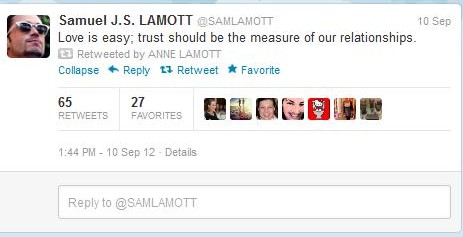 I saw this tweet last week on Anne Lamott’s feed, and I got to thinking.
In grad school, I took a class called Marriage and Interpersonal Relationships in which the professor talked about how people at bottom have either struggles with shame or trust issues. Everyone has a little of both, but either shame or trust is the key component in why we think the way we think, why we act the way we act, and why we end up in the conflict cycles in relationships that we end up in.
After a lot of soul-searching (and a paper we had to write), I finally came to the conclusion that I am a trust-issue person. Somehow, being a shame-issue person seemed better or easier to admit, but when I finally realized the truth about my own woundedness, I began to take steps toward my healing.
I did a lot of work on myself after that, which took years. I remember something a close friend once said about the healing she experienced in her life (as a shame-issue person). She said that the final healing came from her husband.
That’s what I thought of when I read that tweet the other day. I thought about all the work I did to undo the learning I had learned growing up that no one was trustworthy and that I had to take care of everything myself. I thought about all the work I did to learn to do more than say the words with my mouth that God is trustworthy; I also had to believe it in my heart.
But at the end of the day, the final healing came from my relationship with my husband.
When I read that tweet, I thought about how I trust my husband implicitly and completely without the slightest twinge of doubt, suspicion, or jealousy. If he says he’s working late, I know that means he is. If he chats on Facebook with an old girlfriend, I know they really are just friends. I know because every single day since the day we met he has proven with his behavior that I can trust him. I know because even when some embarrassingly irrational fear emerged while we were dating, and I acted out, he said the words I needed him to say and behaved the way I needed him to behave to prove to me again that I can trust him. I know because if he could see the irrational, embarrassing side of me with all the woundedness still left unhealed and still want to date me and marry me and love me forever, he was worthy of my trust.
And it made me think about God, too, and how hard it is for me to trust God. It’s easy to love God, serve God, praise God. But trust? For some people, believing that God loves them, that they are love-able, is the hardest thing. For me, believing God is trustworthy (especially believing that I don’t have to earn it) is the hardest thing. I’ve been slowly healing from this great lie I believed for years, but the final healing came from my husband.
My aunt once said, famously, that sometimes we just want someone with skin on. Sometimes, no matter how many Bible verses we memorize or how much theology we learn about who God is and who we are, we just can’t accept the truth until we receive it from someone with skin on.
That is the beauty of the incarnation. God poured all of that majesty and might and holiness and completeness and divinity into one small, simple, ordinary human being. After everything we had learned, after all our God-encounters throughout history, we just couldn’t get it until we actually saw, felt, heard, and sat at the feet of someone with skin on.
That’s how we’re made.
If my husband — a fallible human being just like I am — can be this honest, this dependable, this trustworthy, then SURELY how much more so is the God we love and serve and praise?
I’m no fool. I don’t expect my husband to be perfect. I know he is not God. I know he will let me down, hurt me, disappoint me, and maybe even betray my trust in him one day. But through his physical presence in my life, I have been able to experience the truth about who God is. All the Bible verses in the world couldn’t do that.
That is body theology.

 Holistic Body Theology